Our Short List of 3

- Best for: Rifle and shotgun shooters who need the cup to stay clear of the stock.
- NRR 23 dB
- 2 hi-gain omnidirectional microphones
- Sound-activated compression with a stated 0.02-second reaction time
- Full dynamic range HD speakers
- Best for: Indoor range regulars who want the echo of each shot cut short.
- NRR 22 dB
- Variable suppression time for indoor echo control
- Recessed microphones
- Runs on 2 AAA batteries, not included
- Best for: Outdoor shooters and anyone who wants a battery-free backup in the range bag.
- NRR 26 dB
- SNR 31 dB
- Weight 0.46 lb
- Certified to ANSI S3.19-1974 and CE EN 352-1
All 3 Picks at a Glance
| Product | Specs | Action |
|---|---|---|
| Walker’s Razor Slim Electronic Muff |
| Check price on Amazon |
| Peltor Sport Tactical 100 Electronic Hearing Protector |
| Check price on Amazon |
| PROHEAR 016 Safety Earmuffs |
| Check price on Amazon |
Key takeaways
- Compare five shooting ear muffs on the figures their Amazon listings state, from electronic models that pass range commands to passive cups at NRR 27 dB.
The real decision with shooting ear muffs is not the biggest number on the box. It is whether you still need to hear the range officer, a ceasefire call, or the shooter beside you between strings of fire. Electronic muffs pass those low sounds through and clamp down the instant a shot breaks; passive muffs block more with plain foam and plastic but leave you lifting a cup to talk. Where you shoot matters as well: an indoor lane bounces each report off concrete, while an outdoor line adds wind across the microphones.
This roundup is for pistol and rifle shooters picking range-day protection, instructors who talk through whole sessions, and hunters who keep muffs on for hours. Every pick is a full over-ear muff listed on Amazon, passive or electronic, chosen from the figures and features its own listing states: the NRR figure in decibels, the power source, the cup shape, and the weight where the page gives one.
Quick Picks
As an Amazon Associate we earn from qualifying purchases.
| Product | Best for | Key spec from title |
|---|---|---|
| Howard Leight Impact Sport Electronic Earmuff | Hearing range commands between strings | NRR 22 dB, directional microphones |
| Walker’s Razor Slim Electronic Muff | Rifle and shotgun work with slim cups | NRR 23 dB, ultra low-profile cups |
| Peltor Sport Tactical 100 Electronic Hearing Protector | Indoor lanes with echo to tame | NRR 22 dB, variable suppression time |
| PROHEAR 016 Safety Earmuffs | A passive set with no batteries to manage | NRR 26 dB, folds for the range bag |
| Walker’s Razor Slim Passive Earmuff | The strongest passive figure in a slim cup | NRR 27 dB, 10.4 ounces |
How to Choose
Amplification or Plain Blocking
Electronic muffs carry microphones and speakers that pass conversation and range commands at a safe level, then shut the sound down when a shot breaks. That awareness is why instructors and squad shooters wear them. Passive muffs skip the circuitry entirely: foam and cup volume do all the work, nothing runs out of power, and the listed NRR figure is often higher for the same money. The trade is communication. If your range time is mostly solo work on a quiet outdoor line, passive blocking is hard to argue with; if you shoot in a group, electronics earn their keep.
Reading the NRR Figure in Context
Every muff here states an NRR figure in decibels, measured in a laboratory with a careful fit. Treat it as a comparison between models, not a promise about your lane. Indoor ranges reflect sound off walls and ceiling, so a shot effectively lasts longer and a modest figure feels thin; many indoor shooters pair muffs with foam plugs underneath for the loudest bays. Outdoors, the same figure goes further because the report escapes. Note also that two muffs with the same figure can feel very different once a stock, a hat brim, or glasses arms break the cushion seal.
Cup Depth, Seal, and Stock Clearance
A muff only delivers its listed figure while the cushion seals all the way around your ear. Deep, wide cups seal easily and feel roomy, but on a rifle or shotgun they meet the stock as you build your cheek weld, and that knock lifts the cup just as the shot fires. Slim and low-profile cups trade a little internal volume for clearance, which is why most shooting-specific models keep the shell shallow and shape the bottom edge to miss the stock. Check the listing’s cup description against the gun you shoot most, and look for replaceable cushions, because flattened foam quietly undoes a good seal.
Power, Controls, and Session Comfort
Electronic models here run on two AAA batteries; one listing includes them, another leaves them to you, so check the box contents before a range trip. Automatic shut-off stretches that power, and the stated working life varies widely between models, from a stated two-hour shut-off window to a stated 350 hours of use. Controls matter with gloves on: a single recessed knob is easier to find by feel than small buttons. Finally, weigh clamping force and total weight. A muff that feels fine for ten minutes can ache by the second hour, and the listing’s stated weight is the honest clue.
The 5 Best Options
Howard Leight Impact Sport Electronic Earmuff
The default choice for shooters who talk as much as they fire. Two directional microphones pick up range commands and conversation and pass them through at a level the listing caps at 82 dB, then cut the amplification the moment a shot pushes past that line. The cups are the slim pattern Howard Leight built its range reputation on, so a rifle stock clears them without a fight, and the headband folds the whole muff down for a range bag. If you shoot club matches or train in a group, this is the muff that keeps you in the conversation.
Specs
- NRR 22 dB
- Directional microphones amplify ambient sound to a safe 82 dB
- Amplification shuts off when sound reaches 82 dB
- Runs on 2 AAA batteries, included
- Stated battery life of about 350 hours, with automatic shut-off after 4 hours
- 3.5 mm audio connection cord included
- Model R-01526
Best for: Group sessions and classes where hearing commands matters as much as blocking shots.
Watch out for: The listed figure is the lowest here, so indoor shooters beside loud rifles may want plugs underneath as well.
ASIN: B001T7QJ9O
Walker’s Razor Slim Electronic Muff
- Best for: Rifle and shotgun shooters who need the cup to stay clear of the stock.
- NRR 23 dB
- 2 hi-gain omnidirectional microphones
- Sound-activated compression with a stated 0.02-second reaction time
- Full dynamic range HD speakers
Rifle and shotgun shooters who need the cup to stay clear of the stock.
The listing gives no weight figure, and the slim cups leave less room for larger ears on long sessions.
Walker’s built this muff around the slimmest cup in its electronic line, aimed squarely at rifle and shotgun shooters whose stock kept shoving bulkier muffs aside. Two hi-gain omnidirectional microphones feed full dynamic range speakers, and the sound-activated compression reacts in a stated 0.02 seconds, so a shot is cut down without clipping the words around it. A single recessed knob handles volume, which gloved hands manage better than buttons, and the frame folds flat. Choose it when cheek weld clearance is the problem you keep running into with standard electronic muffs.
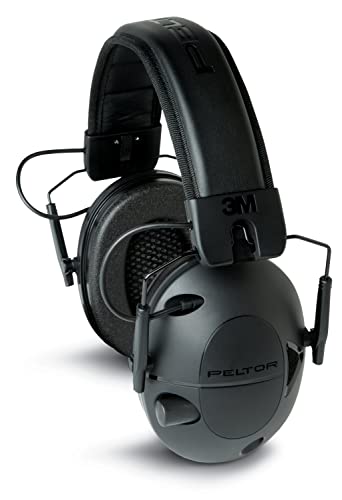
Peltor Sport Tactical 100 Electronic Hearing Protector
- Best for: Indoor range regulars who want the echo of each shot cut short.
- NRR 22 dB
- Variable suppression time for indoor echo control
- Recessed microphones
- Runs on 2 AAA batteries, not included
Indoor range regulars who want the echo of each shot cut short.
Batteries are not in the box, and the stated weight is the heaviest of the electronic picks here.
3M’s entry takes a different route to the same job: instead of a fixed response, its variable suppression time lets you shorten how long the electronics hold a shot’s echo down, which suits indoor lanes where reports ring. Recessed microphones keep wind and handling noise out of the amplified feed, and the cups stay low-profile enough for long guns. It runs on two AAA batteries that the box does not include, and a two-hour automatic shut-off guards them. Pick this one if you split time between an echoing indoor range and outdoor bays and want one muff tuned for both.
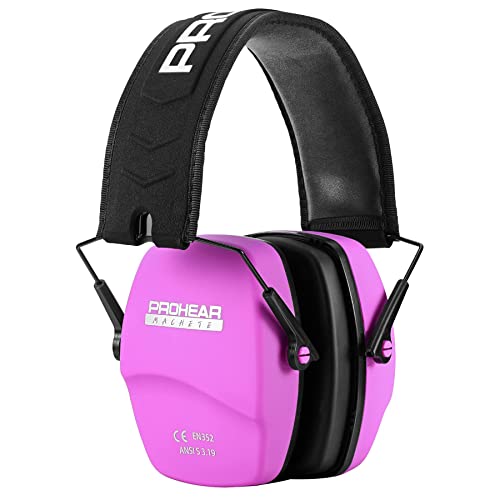
PROHEAR 016 Safety Earmuffs
- Best for: Outdoor shooters and anyone who wants a battery-free backup in the range bag.
- NRR 26 dB
- SNR 31 dB
- Weight 0.46 lb
- Certified to ANSI S3.19-1974 and CE EN 352-1
Outdoor shooters and anyone who wants a battery-free backup in the range bag.
There is no amplification, so conversation means lifting a cup or raising your voice.
The passive pick for shooters who want protection that simply works every time it comes out of the bag. With no microphones, speakers, or batteries, the 016 relies on its composite housing and foam to deliver a listed NRR 26 dB, several points above the electronic models here. The slim cups carry cutouts shaped to clear a firearm stock, the whole muff folds, and at a stated 0.46 lb it is the lightest in this roundup. A drawstring bag is included for the range kit. Choose it as a primary muff for outdoor lines or as the spare that never needs charging.
Walker’s Razor Slim Passive Earmuff
The strongest passive figure in this group sits in the same slim shell as Walker’s electronic Razor. The listing states NRR 27 dB from a purely passive build: ultra low-profile cups on a metal wire frame, with a rubberized coating over the housing. At a stated 10.4 ounces it stays light through a long string, and the cups fold for storage. There is nothing to switch on and nothing to run flat, which suits shooters who store their gear in a truck or a club locker and expect it to work the moment it goes on.
Specs
- NRR 27 dB
- Weight 10.4 ounces
- Ultra low-profile ear cups
- Metal wire frame headband
- Rubberized coating
- Folding design
- Model GWP-RSMPAS-ODG
Best for: Shooters who want the highest listed passive figure without giving up a slim cup.
Watch out for: The listing describes the fit as sized toward smaller heads, so larger shooters should check the fit notes before ordering.
ASIN: B07YXP5KNH
Which One Fits Your Situation
Your Lane Is Indoors, Between Concrete Walls
Indoor reports bounce, and the echo makes a modest NRR figure feel smaller than it reads. Start with the Peltor Sport Tactical 100, whose variable suppression time is built to shorten that ringing, and keep foam plugs in your bag for the bays beside braked rifles. The PROHEAR 016, at NRR 26 dB, is the passive alternative if you would rather skip electronics entirely.
You Shoot Rifle or Shotgun and the Stock Keeps Winning
Every time the cup meets the stock, the seal opens at the shot. The Walker’s Razor Slim Electronic was shaped for exactly this fight, with the slimmest cups in the group and compression fast enough to keep commands clear. Its passive sibling, the Razor Slim Passive, solves the same clearance problem at NRR 27 dB for shooters who do not want electronics on a long gun.
You Instruct, Spot, or Shoot With a Group
Talking through a session changes the brief: you need voices at a safe level all day, not silence. The Howard Leight Impact Sport passes commands through its directional microphones and caps them at 82 dB, and its stated 350-hour battery life means a set of AAA cells lasts a season of weekends. The Tactical 100 is the fallback if your group shoots indoors and echo is the bigger enemy.
You Want a Spare Set That Is Always Ready
A loaner muff for a guest, a backup in the truck, a set for a new shooter: this job wants zero preparation. Both passive picks qualify, but they split on fit and figure. The PROHEAR 016 folds into its drawstring bag at 0.46 lb, while the Walker’s Razor Slim Passive lists the higher figure, NRR 27 dB, in a slim cup. Either one works the moment it leaves the bag, with no batteries to check.
Common Mistakes
- Buying on the NRR figure alone, then wearing the muff over a hat or thick glasses arms that hold the cushion off the ear and quietly throw the seal away.
- Picking deep, wide cups for rifle work and discovering at the first string that the stock knocks the cup loose on every shot.
- Leaving an electronic muff switched on in the range bag, then finding flat batteries at the start of the next session.
- Treating laboratory figures as a guarantee for an indoor lane, where reflected sound keeps each report working longer than the same shot outdoors.
- Never replacing flattened cushions; the seal depends on foam that gives up a little more of its spring every season.
Frequently Asked Questions
Are electronic ear muffs safer than passive ones?
No. The protection in both types comes from the cup, the cushion, and the seal; the electronics only decide what you hear between shots. A passive muff with a listed NRR 26 dB blocks more on paper than an electronic one at NRR 22 dB. Electronics add awareness of commands and conversation, which is a different kind of safety, not extra blocking.
What NRR figure should I look for at an indoor range?
Start at the top of the range listed here, around NRR 26 to 27 dB, because concrete walls and ceiling hand each report back to you more than once. If your lane sits beside loud rifles, wear foam plugs under the muffs as well. Fit still decides the outcome: a higher figure with a broken seal protects less than a lower figure worn correctly.
Can I wear shooting ear muffs over glasses?
Yes, and most range shooters do, but the temple arms cross the cushion and can open a thin gap in the seal. Thinner arms leak less. Seat the muffs first, then settle the glasses over the headband side of the cushion where you can, and press the cups once more before the line goes hot. If you wear glasses all session, favor softer, deeper cushions.
How long do electronic shooting muffs run on a set of batteries?
It depends on the model, and the listings here show the spread. The Howard Leight Impact Sport states about 350 hours from its two AAA batteries, helped by an automatic shut-off after four hours. The Peltor Sport Tactical 100 also runs on two AAA batteries and shuts off after two hours, but its listing states no total hour figure, so carry spares for it.