Key takeaways
- Find the best bridge bathroom faucets for classic and farmhouse bathrooms, with solid brass bodies and timeless two-handle style.
Few fixtures change the character of a bathroom as quickly as the faucet, and the best bridge bathroom faucets do it with a design that has barely changed in a century. A bridge faucet connects its two handles with a visible horizontal bar, or bridge, that carries water from the valves to a tall central spout. The result is a fixture that looks like it belongs in a Victorian townhouse, a farmhouse, or a cottage bathroom, while working with modern plumbing standards underneath.
Bridge faucets are not the right choice for every vanity. They need three deck holes, a fixed spread between the outer holes, and enough clearance behind the sink for the raised bridge. But when the sink and the style line up, no other faucet shape delivers the same presence. This guide explains how to choose one, compares two solid brass models that are sold on Amazon, and answers the questions buyers ask most before ordering.
How to Choose
1. Confirm the Hole Spread
A bridge faucet is built around a fixed distance between its two valve bodies, most commonly 8 inches on center, though some models adjust from 4 to 8 inches. Measure the distance between the centers of your outer sink holes before you shop. If your holes are drilled at a different spread, a rigid bridge faucet will not fit, and no adapter will fix it. Adjustable-center models give you more room for error, which matters on stone counters where the holes are already cut.
2. Check Spout Height and Reach
Bridge faucets usually have a high-arc spout, which is part of their charm and part of the planning. Spout height determines how much room you have for washing hands and filling containers, while spout reach determines whether the water lands in the middle of the basin or splashes near the back edge. Measure from the deck to the underside of the spout and from the center of the faucet base to the center of the aerator, then compare those numbers with the depth of your basin. A deep vessel sink needs more reach than a shallow undermount basin.
3. Look for Solid Brass Construction
The bridge itself is a structural piece, and its weight tells you a lot about what is inside. Solid brass bodies resist corrosion, hold their finish, and feel substantial when you operate the handles. Lighter zinc or plastic-bodied faucets may look similar in a photograph, but they tend to wear faster at the valve seats and the threaded connections. Check the product specifications for brass construction and a ceramic disc cartridge, which shuts water off with a quarter turn and is far less prone to dripping than older compression washers.
4. Match the Handles to the Users
Bridge faucets come with lever handles, cross handles, or porcelain-accented handles. Lever handles are the easiest to operate with wet or soapy hands and meet accessibility guidelines in most cases, which makes them a practical choice for a family bathroom or a guest bath used by older visitors. Cross handles look more period-correct and suit a restoration project, but they require a full grip to turn. Porcelain inserts add a classic touch and are easy to wipe clean, though they can chip if struck by a hard object.
5. Decide on the Finish
Polished chrome is the most forgiving finish: it matches nearly any other fixture, resists water spots reasonably well, and suits both traditional and transitional bathrooms. Polished brass and brushed brass bring warmth and suit farmhouse, English country, and vintage styles, but they show water spots more readily and need regular wiping to keep their shine. Oil rubbed bronze and matte black make a stronger statement and hide spots well, yet they can be harder to match with existing towel bars, mirrors, and lighting. Choose the finish after you have looked at the other metal in the room, not before.
6. Verify the Drain and Connections
Many bridge faucets include a matching pop-up drain and tailpiece, which saves a separate purchase and guarantees the finish matches. Confirm whether the drain is included, and check the connection size, usually a standard half-inch NPSM or IPS thread, against your supply lines. If your shut-off valves are older or use a different thread, budget for adapters or new supply lines. Also confirm the maximum deck thickness the faucet accepts, since thick stone counters can exceed the reach of the mounting shanks on some models.
7. Plan for the Plumber
Bridge faucets are heavier and more complex to install than a single-handle faucet, and the rigid bridge leaves little room for adjustment once the valves are set. If you are replacing an existing widespread faucet, the swap is usually straightforward. If you are cutting new holes in stone, have the faucet in hand before the fabricator drills, so the spread is exact. A licensed plumber can also confirm that your water pressure suits the faucet’s flow rate and that the hot and cold supplies line up with the handle markings.
Top Picks
Kingston Brass English Country Bridge Bathroom Faucet, Polished Brass (KS7972AL)

The Kingston Brass English Country bridge faucet is the classic expression of this style: a high-arch spout, two lever handles, and an exposed bridge bar, all in a warm polished brass finish. It is built from solid brass with a drip-free ceramic disc cartridge, and it includes a matching brass pop-up drain, so the whole assembly arrives in one finish.
Key specifications include a 1.2 GPM flow rate at 60 PSI, a standard half-inch NPSM connection, a spout height of 10.75 inches, and a spout reach of 4.75 inches. It mounts on the deck with a three-hole installation and weighs about 7.5 pounds, which gives it a solid feel at the handles. The lever handles meet accessibility guidelines, and the overall look suits English country, farmhouse, and traditional bathrooms, especially those with marble or warm-toned stone counters.
Who it is for: homeowners restoring a period bathroom or building a farmhouse-style vanity who want the warmest, most traditional finish in this guide. It pairs well with brass lighting, warm wood vanities, and console sinks with exposed legs.
Caveats: polished brass shows water spots and fingerprints more than chrome, so it needs regular wiping in a hard-water home. The fixed bridge means the hole spread must be exact, so measure before ordering. As with any polished brass fixture, keep abrasive cleaners away from the finish.
Kingston Brass Tudor Bridge Lavatory Faucet, Polished Chrome (KS7991TAL)
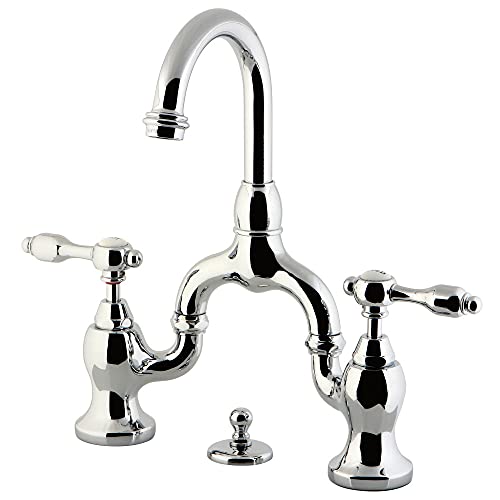
The Kingston Brass Tudor bridge faucet takes the same bridge layout in a cooler, more versatile direction. Its polished chrome finish and high-arc spout suit traditional bathrooms as well as transitional spaces where brass would feel too warm. It is also built from solid brass with a drip-free ceramic disc cartridge, and it includes a matching brass pop-up drain.
Key specifications include a 1.2 GPM flow rate at 60 PSI, a standard half-inch IPS connection, a spout reach of 4-5/8 inches, and 8-3/8 inches of spout clearance beneath the arc. It mounts on the deck with a three-hole installation adjustable from 4 to 8 inches on center, which gives it more flexibility than a fixed-spread bridge when the existing holes are not exactly 8 inches apart. The lever handles are easy to grip, and the chrome finish is the easiest of the two picks to match with other fixtures.
Who it is for: buyers who love the bridge silhouette but want a finish that blends with chrome towel bars, mirrors, and shower trim, or anyone whose sink holes are not drilled at exactly 8 inches. It is a strong choice for a guest bathroom or a rental property where durability and easy matching matter.
Caveats: the spout reach is modest, so it suits standard undermount and drop-in basins better than very deep vessel sinks. Chrome can show water spots in hard-water areas, though it wipes clean easily. Confirm the adjustable center range against your actual hole spacing before ordering, since the bridge still needs both valve bodies seated squarely on the deck.
Comparison Table
| Feature | Kingston Brass English Country (KS7972AL) | Kingston Brass Tudor (KS7991TAL) |
|---|---|---|
| Finish | Polished Brass | Polished Chrome |
| Construction | Solid brass | Solid brass |
| Cartridge | Ceramic disc | Ceramic disc |
| Flow rate | 1.2 GPM at 60 PSI | 1.2 GPM at 60 PSI |
| Mounting | Deck mount, 3-hole | Deck mount, 3-hole |
| Hole spread | Fixed bridge centers | Adjustable 4 to 8 inches |
| Spout height | 10.75 inches | High arc |
| Spout reach | 4.75 inches | 4-5/8 inches |
| Spout clearance | 8-1/16 inches | 8-3/8 inches |
| Handles | Lever handles | Lever handles |
| Connection | 1/2-inch NPSM | 1/2-inch IPS |
| Pop-up drain | Included, matching brass | Included, matching finish |
| Weight | About 7.5 pounds | Solid brass build |
| Best for | Warm traditional and farmhouse baths | Chrome-matched and transitional baths |
Which One Is Right for You?
Choose the English Country model in polished brass if the bathroom already leans warm: brass lighting, a wood vanity, or a marble top with gold veining. Its finish is the statement, and it looks most at home in a farmhouse or period restoration where the faucet is meant to be noticed. Just be ready to wipe it down regularly and to measure your hole spread exactly.
Choose the Tudor model in polished chrome if you want the bridge shape without committing to a warm metal, or if your sink holes are not at a perfect 8-inch spread. Its adjustable centers and chrome finish make it the more forgiving of the two, and it blends into a wider range of bathrooms, from a classic guest bath to a transitional remodel with mixed metals.
If your basin is a deep vessel sink, neither of these two is the right choice on reach alone, and you should look for a bridge model with a longer spout reach or consider a vessel-height faucet instead. If your sink has only one hole, or a 4-inch centerset drilling, a bridge faucet will not fit at all, and a centerset or single-hole faucet is the right call.
Frequently Asked Questions
What is a bridge bathroom faucet?
A bridge bathroom faucet has two separate handles, one for hot and one for cold, joined by a visible horizontal bar called the bridge. Water travels from the valves through the bridge to a tall central spout. The design dates to the late nineteenth and early twentieth centuries, when exposed plumbing was a feature rather than something to hide, and it remains popular in traditional, farmhouse, and vintage-style bathrooms.
Will a bridge faucet fit my sink?
It fits a three-hole deck-mount sink where the outer holes match the faucet’s spread. Most bridge faucets are built for an 8-inch spread, while some adjust from 4 to 8 inches. Measure the distance between the centers of your outer holes and compare it with the faucet’s specifications before ordering. If your sink is drilled for a single hole or a 4-inch centerset, a bridge faucet will not fit without replacing the sink or the countertop.
Are bridge faucets hard to install?
They are more involved than a single-handle faucet because the two valve bodies and the bridge must be aligned and seated evenly, and the fixture is heavy. A confident do-it-yourselfer with basic plumbing tools can usually install one in place of an existing widespread faucet. For new stone counters, have the faucet on site before the holes are drilled, and consider a licensed plumber to confirm the supply connections and the deck thickness.
How do I keep a bridge faucet looking good?
Wipe the faucet dry after use in hard-water homes, clean it with mild soap and a soft cloth, and avoid abrasive pads and harsh chemical cleaners that can damage the finish. Periodically check the aerator for mineral buildup and clean it by soaking it in vinegar. The ceramic disc cartridge should give years of drip-free operation, and if a handle ever feels loose, the fix is usually a simple adjustment of the handle screw or the valve bonnet.
Disclosure: As an Amazon Associate, we may earn from qualifying purchases.