Our Short List of 3

- Best for: professional and frequent cutting where a documented standard matters.
- Model: 587160704
- Shell: 1000-denier polyester with PVC coating
- Protection: 5 layers of TEK WARP protective material
- Style: apron wrap
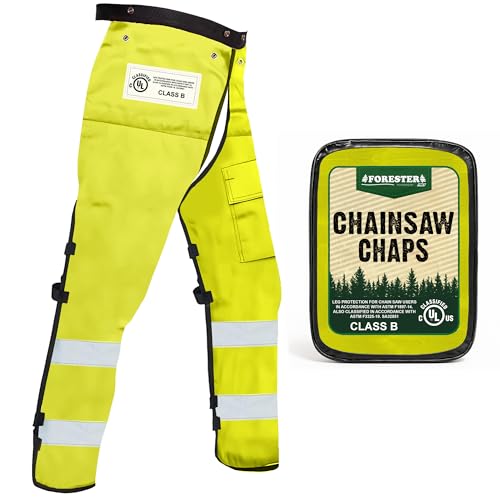
- Best for: homeowners and farm users who want the deepest layer stack in a simple apron.
- Style: apron
- Shell: 1200-denier oxford, water and oil resistant
- Protection: 12 layers
- Pocket: 6 by 6 inches

- Best for: limbing and brush work where the calf needs coverage too.
- Protection: 8 layers — 6 cut-resistant plus 2 cushioning
- Standards named in the listing: UL classified, ASTM F1897-20, ASTM F3325-20, OSHA Regulation 1910-266
- Shell: 1050D polyester with PU coating
- Buckles: YKK or ITW, with 3M reflective stripe
All 4 Picks at a Glance
| Product | Specs | Action |
|---|---|---|
| Husqvarna Technical Apron Wrap Chainsaw Chaps |
| Check price on Amazon |
| FORESTER Chainsaw Chaps |
| Check price on Amazon |
| YARDMARIS Chainsaw Chaps Technical Class B |
| Check price on Amazon |
 AYKRM Timber Chainsaw Chaps |
| Check price on Amazon |
Key takeaways
- Compare 4 chainsaw chaps for logging and firewood work, from apron styles to calf-wrap designs, with layer counts and standards that matter most.
Choosing chainsaw chaps starts with a blunt question: if the chain leaves the bar and crosses your leg, what stands in the way? Every pair in this guide answers with layers of fibers designed to tear loose, jam the sprocket and slow the chain, and each one states the standard its maker had it tested against. The real decision is how much coverage you need — a fast apron for bucking firewood, or a wrap that also guards the calf when you limb and cut brush.
This guide is for homeowners splitting a winter of firewood, farmers clearing fence lines, and crews who cut every day. The four picks come straight from current Amazon listings: a saw maker’s pro apron wrap, a twelve-layer value apron, a Class B design that wraps the calf, and a high-visibility wrap with a wedge pouch. Each entry sticks to what its listing actually states — layer counts, shell fabrics, sizing and the standards named on the page.
Quick Picks
As an Amazon Associate we earn from qualifying purchases
| Product | Best for | Key spec from title |
|---|---|---|
| Husqvarna Technical Apron Wrap Chainsaw Chaps | Full-time saw work | 1000-denier shell with 5 Tek Warp layers |
| FORESTER Chainsaw Chaps | Home firewood cutting | 12-layer protection in a 1200-denier shell |
| YARDMARIS Chainsaw Chaps Technical Class B | Calf coverage | 8 layers with foreleg and calf wraps |
| AYKRM Timber Chainsaw Chaps | Visibility and tool carry | 8-layer lining with wedge pouch |
How to Choose
Certification and the Standards on the Label
Start with the label, because chaps are one purchase where paperwork matters. In the United States, the benchmark is ASTM F1897, the standard for chainsaw leg protection, and many listings also cite OSHA Regulation 1910-266, the logging rule that requires leg protection for saw operators. A UL listing or classification means an outside laboratory has examined the product against the standard rather than the maker simply claiming compliance. The Husqvarna and YARDMARIS listings name their standards outright; when a listing stays vague about testing, treat that silence as information and keep shopping.
Apron Coverage Versus Full Wrap
Apron chaps hang from the waist and shield the front of each leg, which is where most chain contact happens during bucking and felling. They are lighter, cooler and quick to buckle on over work pants, as the FORESTER and AYKRM designs show. Wrap chaps carry the protective pad around the calf as well, guarding the back of the lower leg during limbing, brush cutting and work on slopes. The YARDMARIS Class B follows that pattern. The trade is bulk and warmth: a wrap covers more, and you feel every extra layer on a summer afternoon.
Layer Count and Shell Fabric
Layer count is the headline number, but it only tells half the story. The fibers do the work by pulling free and clogging the sprocket, so more layers generally mean more material to jam the chain — the FORESTER stacks twelve, while the Husqvarna Tek Warp system uses five engineered layers under a heavier shell. Denier describes the shell yarn’s weight: a 1000- or 1200-denier oxford shrugs off brush and bar oil better than lighter cloth, while a 600D ripstop trades some toughness for flexibility. Match the stack to how often and how hard you cut.
Waist and Length Fit
Chaps protect only the leg they actually cover, so sizing deserves the same care as the saw choice itself. Measure your waist over the pants you cut in, then check the overall length, which makers measure from the waist toward the instep rather than by inseam alone. FORESTER sells three lengths from 35 to 40 inches, YARDMARIS splits its range into three sizes, and AYKRM leans on an adjustable waistband. The hem should end above the boot top without pooling on the ground, and every strap should snug down without cutting off movement when you kneel.
The 4 Best Options
Husqvarna Technical Apron Wrap Chainsaw Chaps
- Best for: professional and frequent cutting where a documented standard matters.
- Model: 587160704
- Shell: 1000-denier polyester with PVC coating
- Protection: 5 layers of TEK WARP protective material
- Style: apron wrap
professional and frequent cutting where a documented standard matters.
this listing covers the 36- to 38-inch size, so taller users need the longer variant instead.
Husqvarna builds the Technical Apron Wrap for people who run a saw all week, and the construction matches that brief. A 1000-denier polyester shell with a PVC coating shrugs off bar oil, fuel splashes and brush, while five layers of Tek Warp fill sit underneath, designed to pull apart and clog the sprocket when a chain makes contact. The apron-wrap cut covers the front of the leg and wraps the calf, and the listing pairs it with an adjustable belt and a gear pocket sized for a felling wedge. Two length options keep the hem off the boot tops.
FORESTER Chainsaw Chaps
- Best for: homeowners and farm users who want the deepest layer stack in a simple apron.
- Style: apron
- Shell: 1200-denier oxford, water and oil resistant
- Protection: 12 layers
- Pocket: 6 by 6 inches
homeowners and farm users who want the deepest layer stack in a simple apron.
the listing states these chaps are not suitable protection for use with electric chainsaws.
FORESTER’s apron chaps are aimed at owners who cut firewood and clear storm damage a few weekends a year. The listing puts twelve protective layers behind a 1200-denier oxford shell that resists water and oil, and it states the chaps are UL listed and meet OSHA requirements. A six-by-six-inch pocket carries a scrench or wedge, the waist adjusts across a wide range, and three overall lengths help match the chaps to your height. Because the back of the leg stays open, they go on quickly over work pants and come off just as fast at the truck.
YARDMARIS Chainsaw Chaps Technical Class B
- Best for: limbing and brush work where the calf needs coverage too.
- Protection: 8 layers — 6 cut-resistant plus 2 cushioning
- Standards named in the listing: UL classified, ASTM F1897-20, ASTM F3325-20, OSHA Regulation 1910-266
- Shell: 1050D polyester with PU coating
- Buckles: YKK or ITW, with 3M reflective stripe
limbing and brush work where the calf needs coverage too.
the wrap design takes longer to put on than an apron, and the brand sells several versions, so check the Class B name when ordering.
Most chaps guard the front of the leg and stop there. The YARDMARIS Technical Class B goes further, wrapping the foreleg and the calf, which matters when you are limbing on a slope or cutting brush where the bar can swing toward the back of the leg. Its eight layers split into six cut-resistant layers and two cushioning layers inside a 1050-denier PU-coated shell. The listing states the chaps are classified by UL and meet ASTM F1897-20, ASTM F3325-20 and OSHA Regulation 1910-266. Hardware comes from YKK or ITW, and a 3M reflective stripe runs across the design.
AYKRM Timber Chainsaw Chaps
- Best for: low-light work and users who carry wedges and small tools on the belt.
- Shell: 600D ripstop oxford fabric with grid weave
- Protection: 8-layer protective lining
- Wedge pouch: dedicated pouch, wooden wedges included per the listing
- Detailing: reflective strips on the legs
low-light work and users who carry wedges and small tools on the belt.
the listing description does not name a UL or ASTM certification, so buyers who need a documented standard should start with the certified picks above.
AYKRM dresses its apron wrap for visibility and small-item storage, two things most chaps ignore. The shell is a 600D ripstop oxford with a grid weave that resists tearing, and eight protective layers sit behind it. A dedicated pouch holds wooden wedges, which the listing includes, while reinforced waist attachment points, a webbing loop and a plastic D-ring give gloves and tools somewhere to clip. Reflective strips run down the legs for low-light work, the waistband adjusts, and the listing describes articulated knees that let the chaps move when you crouch over a log.
Which One Fits Your Situation
You Cut Firewood at Home a Few Weekends a Year
An apron you can buckle on in the driveway is the right scale of gear here. The FORESTER gives you a twelve-layer stack and a water- and oil-resistant shell without a complicated strap system, plus a pocket for the scrench. Its open back keeps it cooler during short sessions, and the three lengths make it easier to avoid a hem that drags in the sawdust.
You Run a Saw Daily for Work
Daily cutting justifies the heaviest shell in this guide. The Husqvarna Technical pairs a 1000-denier PVC-coated shell with five Tek Warp layers and an apron-wrap cut that also covers the calf, and its listing names the ASTM, ANSI and OSHA standards it meets — the paperwork a crew lead or insurer may ask for. The gear pocket keeps a felling wedge on your leg instead of in the truck.
You Limb Trees and Cut Brush on Uneven Ground
Limbing puts the bar near the back of your legs, exactly where aprons leave you bare. The YARDMARIS Class B wraps the foreleg and the calf with eight layers, and its UL classification plus the two ASTM standards named in the listing suit buyers who need documented protection. The 3M reflective stripe helps when the workday runs past the light.
You Cut Near Roads or in Low Light and Carry Small Tools
Roadside cleanup and evening storm work call for being seen and keeping wedges close. The AYKRM wraps reflective strips around the legs, includes a wedge pouch with wedges, and adds clip points for gloves and tools. Its eight-layer lining sits behind a ripstop shell, and the included storage bag keeps the set together in the truck box between jobs.
Common Mistakes
- Sizing by waist alone and ignoring overall length, so the hem pools over the boots or leaves the lower shin exposed.
- Running an electric chainsaw in chaps whose listing excludes electric saws — the FORESTER listing states that limit outright.
- Keeping a pair in service after it has stopped a chain; the fibers are spent once they have been pulled into a sprocket.
- Washing against the care instructions, since harsh cycles and the wrong detergents can damage the protective fill — follow the label.
- Wearing chaps loose, because straps left dangling let the pad shift away from the part of the leg it is meant to cover.
Frequently Asked Questions
Do chainsaw chaps work with electric chainsaws?
Check the individual listing before assuming. FORESTER states plainly that its chaps are not suitable protection for electric chainsaws, citing the high-torque nature of electric motors, and other makers print similar limits. If you run a battery or corded saw, buy only chaps whose listing explicitly covers electric models, and treat silence on the point as a no.
What does UL classified or UL listed mean on chaps?
It means Underwriters Laboratories, an independent testing organization, has evaluated the product against the relevant standard — for chaps, typically ASTM F1897 for leg protection. Listings in this guide use both listed and classified wording; either signals third-party involvement, which carries more weight than a maker’s unsupported claim of meeting a standard on its own.
How should chainsaw chaps fit?
Snug at the waist, with every leg strap buckled so the pad cannot rotate, and long enough to cover from the waist toward the instep without dragging on the ground. Makers size by overall length rather than inseam, so measure from your waist, over the pants you cut in, to the top of your boot and match that number to the size chart.
When should chainsaw chaps be replaced?
Immediately after they stop a chain — the protective fibers work by tearing loose and jamming the sprocket, and that section cannot do the same job twice. Also replace chaps with a torn shell, missing straps or damaged buckles, and follow the maker’s care instructions in the meantime so the fill stays evenly distributed and ready.