Key takeaways
- Learn how to choose the best bridge bathroom faucets for vessel sinks: spout height, reach, hole spacing, mounting style, finishes, and fit explained.
As an Amazon Associate we earn from qualifying purchases.
A bridge faucet looks simple on a showroom wall, yet pairing one with a vessel sink is one of the trickiest matches in bathroom design. The two handles are joined by an exposed horizontal pipe, the spout arches from the center, and the whole fixture must clear a bowl that sits several inches above the counter. Get the height or reach wrong and water lands on the rim, splashes across the vanity, or leaves too little room to wash your hands.
This guide is written for renovators restoring a period bathroom, homeowners who fell in love with the exposed-pipe look, and anyone replacing a tall single-handle faucet with something more traditional. Every dimension and feature mentioned here comes from manufacturer specification sheets and retailer listings for real bridge bathroom models, so you can compare the numbers against your own sink and countertop before ordering.
How to Choose
A bridge bathroom faucet is a narrow category, and that scarcity shapes every buying decision. Most faucets sold under the bridge name are built for kitchens, with taller bodies, wider hole spacing, and no pop-up drain, so a bathroom search can easily surface the wrong fixture. The genuine bathroom versions come from a small group of traditional manufacturers, led by Kingston Brass, and they divide into deck-mount models that sit on the countertop and wall-mount models that attach to the wall behind the sink. Vessel bowls add a second layer of difficulty, because the rim rises well above the deck and shortens the working space under the spout. The four checks below, applied in order, will tell you whether a particular bridge model belongs on your vanity or should stay in the catalog.
Spout Height and Clearance Above the Rim
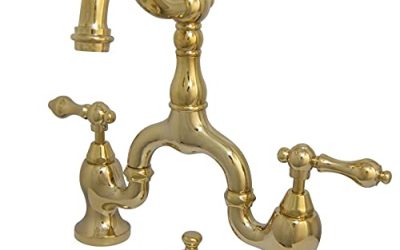
Spout height and spout clearance are two different numbers, and confusing them is the most common sizing error with vessel sinks. Overall height runs from deck to the top of the arch, while clearance is the open space beneath the spout outlet, the room your hands actually use. A vessel bowl that rises four or five inches above the counter can swallow most of that clearance, so look for models with at least eight inches of it. The Kingston Brass Restoration bridge faucet, for example, lists 11.5 inches of overall height with 8.5 inches of clearance, a combination that suits medium-depth bowls. Measure your bowl first, then subtract its rim height from the clearance figure before deciding.
Spout Reach and Where the Water Lands
Reach decides whether the stream falls near the center of the bowl or strikes the back wall and sprays outward. Most vessel sinks are round or oval with a central drain, so the spout outlet should sit roughly above that center point. Deck-mount bridge faucets typically offer seven to nine inches of reach; the Restoration model reaches nine inches, while the Belknap bridge model reaches a little less. Wall-mount bridge faucets behave differently, because their reach is measured from the wall rather than from a deck hole, and models such as the Kingston Brass KS315 stretch past twelve inches. Before ordering, mark the drain center on your countertop and measure back to the planned faucet position.
Hole Spacing, Deck Thickness, and Mounting Style
Bridge faucets are fixed-geometry fixtures, so the holes in your countertop must match the faucet rather than the other way around. Most deck-mount bridge bathroom faucets take three holes on eight-inch centers, with the valve bodies at the ends, the spout in the middle, and the bridge pipe leaving no room for adjustment. A few widespread-style models allow a range of spacing, but a true exposed bridge does not flex. Wall-mount versions avoid the deck entirely, needing two wall holes plus solid blocking behind the tile or plaster and supply lines roughed in at the right height. Check deck thickness too, since thick stone tops can exceed the threaded shank length of some valve bodies.
Construction, Flow Rate, and Finish
The bridge faucets worth buying are built from solid brass with ceramic disc cartridges, a combination that resists corrosion and keeps the quarter-turn handles drip-free for years. Cheaper zinc or plastic bodies may look identical in photographs, yet they wear faster at the valve seats and feel lighter in the hand. Bathroom models run at 1.2 gallons per minute at 60 PSI, which suits handwashing without overwhelming a shallow vessel bowl. Finish deserves attention too, because brushed nickel, polished chrome, oil rubbed bronze, polished brass, and matte black each age differently. Match the finish to your drain, mirror frame, and lighting, and confirm that the pop-up drain is included in the same finish rather than sold separately.
Which One Fits Your Situation
Bridge faucets are not one-size-fits-all, and the right choice depends on the bowl in front of you rather than on the fixture alone. A shallow glass vessel and a deep stone bowl can demand opposite answers from the same catalog, while a wall-mount installation changes the geometry completely. The four situations below cover the combinations that appear most often, so find the one closest to your bathroom and use it as your starting point.
A Shallow Glass Vessel on a Standard Vanity
A shallow glass bowl, around three inches tall, forgives the most sizing errors. A deck-mount model with eight inches of spout clearance gives comfortable hand room, and a reach of seven to eight inches centers the stream over most round bowls. Polished chrome or brushed nickel keeps the look light and suits the transparency of the glass. Because the bowl is shallow, splashing stays manageable even at full flow, so choose on style first and confirm the dimensions second.
A Deep Stone or Ceramic Vessel Bowl
Deep bowls, five inches or taller, need the tallest bridge faucet available; many models will not clear them. Look for a deck-mount bridge with at least 11 inches of overall height and 8.5 inches of clearance, such as the Restoration line, or use a wall-mount bridge to set the spout height yourself. Reach matters more here, since the water falls farther and an off-center stream sprays harder. Test the fit with a cardboard mock-up before cutting the countertop.
A Period Restoration With a Marble Top
For restorations, a bridge faucet often becomes the room’s visual anchor. Polished brass or oil rubbed bronze with cross or lever handles suits marble, subway tile, and a traditional mirror. The catch is the countertop: fabricators cut three holes on exact eight-inch centers, so confirm the spacing on the specification sheet before the stone is drilled. Order the matching pop-up drain in that finish, and check the valve bodies suit your deck thickness, since older vanities use thicker slabs.
A Small Powder Room With a Wall-Mounted Setup
Tight powder rooms often suit a wall-mount bridge faucet best. Wall mounting frees the countertop, removes the hole-spacing problem, and sets the spout at the exact height your bowl needs. The trade-off is plumbing work: supply lines must be roughed into the wall, blocking added behind the finish surface, and the reach made long enough to clear the back edge of the bowl. Twelve inches of reach handles this well, provided the wall is opened before tiling rather than after.
Common Mistakes
Bridge faucets punish guesswork more than most fixtures, because their fixed geometry leaves little room to correct an error after installation. These five mistakes appear again and again in vessel sink projects, and each one is easy to avoid with a tape measure and a careful reading of the specification sheet.
- Buying a kitchen bridge faucet for the bathroom. Kitchen bridge faucets are taller, wider, and built for eight-inch or wider sink decks, and they ship without the pop-up drain a bathroom sink needs. A model labeled for kitchen use may look identical in a listing photo, yet its hole spacing, flow rate, and included parts will not match a bathroom vanity. Filter every search to bathroom faucets and confirm the words bathroom and pop-up drain on the specification sheet.
- Measuring overall height instead of clearance. A faucet that stands 11 inches tall can still leave only six inches of usable space under the spout once the arch and outlet are accounted for, and a vessel rim can consume most of that. Always work from the spout clearance figure, subtract the height of your bowl above the counter, and make sure at least four inches of hand room remain after the subtraction.
- Assuming eight-inch centers fit every countertop. True bridge faucets are rigid, so the two valve holes must sit exactly where the bridge pipe expects them, and a half-inch error means the fixture will not assemble. Measure the center-to-center distance on your existing holes or confirm it with your fabricator before ordering, and remember that widespread faucets with adjustable spacing are a different product from a fixed bridge faucet.
- Ignoring the drain and the overflow. Vessel sinks often use a different drain from undermount basins, and a pop-up drain that fits one bowl may not suit another. Check whether your sink has an overflow, whether the faucet includes a matching pop-up drain, and whether the drain finish matches the faucet. Ordering the drain separately after installation usually means a second delivery and a finish that does not quite match.
- Ordering without confirming current availability. Bridge bathroom faucets are a niche product, and individual finishes can go out of stock or be discontinued while listings stay live. Before placing an order, confirm with the seller that the exact model and finish are available, check the return policy for a fixture that may not fit, and keep the specification sheet on hand so the plumber can verify hole spacing and deck thickness on arrival.
Frequently Asked Questions
Can a bridge faucet work with any vessel sink?
A bridge faucet can work with many vessel sinks, but not with all of them. It comes down to the bowl height above the counter, the drain position, and the spout reach. Shallow and medium-depth bowls pair well with tall deck-mount bridge models, while very deep bowls usually need a wall-mount bridge set at a custom height. Measure the bowl against the clearance and reach figures before ordering.
How high should the spout sit above a vessel sink?
The spout outlet should sit high enough to leave comfortable hand room after the bowl rim is taken into account. As a practical target, look for at least four inches of open space between the spout underside and the vessel rim top, with six inches feeling more comfortable for everyday washing. Deck-mount bridge faucets with 8.5 inches of clearance meet this target for most medium-depth bowls.
Do bridge bathroom faucets need three holes?
Most deck-mount bridge bathroom faucets need three countertop holes, one per valve handle and one for the central spout, typically spaced eight inches apart. Wall-mount bridge faucets are the exception, since they need two holes in the wall instead and leave the countertop untouched. If your vanity has a single hole, a bridge faucet will not fit without drilling additional holes or replacing the top.
Are wall-mount bridge faucets better for vessel sinks?
Wall-mount bridge faucets are often the better choice for vessel sinks because you can set the mounting height to suit the bowl rather than accepting a fixed deck-mount height. They also free up counter space and avoid the rigid hole-spacing problem of deck-mount models. The drawback is the installation work, since the wall must be opened for supply lines and blocking, so they suit remodels more than quick replacements.