Our Short List of 3
All 4 Picks at a Glance
| Product | Specs | Action |
|---|---|---|
| 1. Schumacher DSR ProSeries INC100 100A Car Battery Charger and Power Supply | Check price on Amazon | |
 2. AUTOOL EM355 120A Flash Reprogramming Power Supply | Check price on Amazon | |
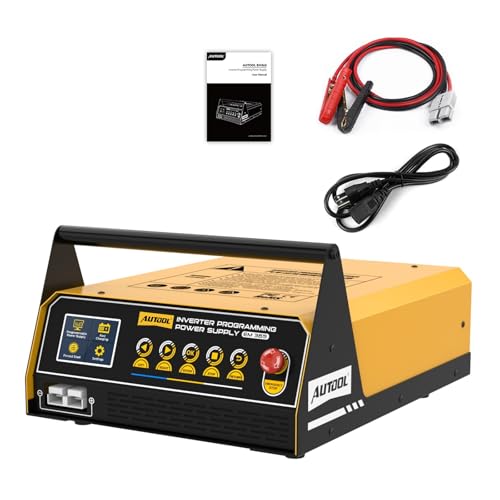 3. AUTOOL EM365 150A Inverter Programming Power Supply | Check price on Amazon | |
 4. PowerMax PMBC-75 75A Battery Maintainer and Charger | Check price on Amazon |
Key takeaways
- Compare the best battery support units for ECU programming and diagnostics, with stable voltage, high current, and key safety features explained.
A battery support unit is the piece of workshop equipment that keeps a vehicle’s electrical system steady while a technician reprograms a control module, runs a long diagnostic session, or calibrates a driver-assistance system. Without one, the battery voltage sags as the ignition stays on, modules draw current, and fans cycle, and a flash procedure can stall halfway through. A stalled flash can leave a module unusable, so shops treat stable support voltage as a requirement rather than a convenience. The right unit holds its output steady for the whole session, delivers enough current for the vehicle in front of it, and protects both the vehicle and itself when something goes wrong.
The units in this guide are all built for the same job: supplying clean, stable direct current to a 12-volt vehicle electrical system during programming, diagnostics, and battery service. They differ mainly in current output, voltage control, and extra functions such as charging, battery restoration, or emergency starting.
As an Amazon Associate, we earn from qualifying purchases.
Quick Answer
For most workshops, a 100-amp battery support unit with an adjustable output between roughly 13 and 16 volts covers the widest range of programming and diagnostic work. Smaller 75-amp units suit lighter vehicles and shorter sessions, while 120-amp and 150-amp units suit large vehicles and long flashes. Match the current rating to the heaviest vehicle you expect to service, and confirm the voltage on the display before every procedure.
1. Schumacher DSR ProSeries INC100 100A Car Battery Charger and Power Supply
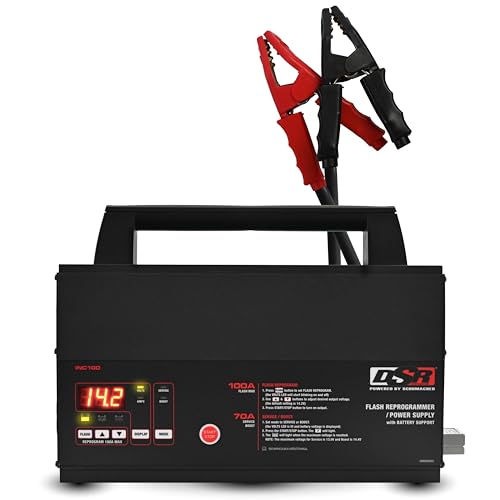
The Schumacher DSR ProSeries INC100 is the most workshop-ready unit in this guide, and the one whose name says exactly what it does: flash reprogrammer and power supply with battery support. It is built around a 100-amp flash mode for programming work and a 70-amp service and boost mode for longer running, which covers the current draw of most passenger cars and light trucks while a module is being written. The digital display shows the output voltage at a glance, so a technician can confirm the support voltage before starting a procedure rather than guessing from a dial position.
Build quality is a strong point here. The INC100 sits in a durable aluminum case with a large carry handle, which matters in a bay where equipment gets moved between lifts, rolled over concrete, and stacked on benches. The heavy-duty clamps have replaceable jaws, so a worn clamp does not mean replacing the whole unit. That kind of serviceable design is exactly what separates professional shop equipment from disposable consumer gear, and it is one reason this unit shows up in dealership service bays.
In use, the INC100 works as a charger, a maintainer, and a support supply. Flash mode holds voltage steady during reprogramming, service mode keeps the system powered during diagnostics and battery replacement, and the charging modes handle routine battery care between jobs. The 100-amp flash rating is a maximum, while the 70-amp continuous rating is the number that matters for long sessions, so it is worth checking both figures against the vehicle manufacturer’s service information before a long flash. For a general repair shop that services a mixed fleet of cars and light trucks, this balance of current, durability, and clear controls is hard to beat.
2. AUTOOL EM355 120A Flash Reprogramming Power Supply
The AUTOOL EM355 is a dedicated programming power supply aimed squarely at ECU flashing and module work, and its headline figure is a 120-amp maximum output that can be sustained for three minutes. That burst capacity covers the current spikes that occur when modules wake up, fans start, and several systems draw power at once during a flash. Between bursts, the unit settles into its charging and support roles, with an adjustable output range from 10.8 to 16.0 volts that lets a technician set the exact support voltage a procedure calls for.
Charging is more capable than the programming figures alone suggest. The EM355 charges lead-acid batteries at 20 amps when the battery is out of the vehicle and at 40 amps for in-vehicle charging, and it supports standard lead-acid, AGM in flat and spiral forms, EFB, and gel batteries. A pulse-based battery restoration function aims to revive deeply discharged or sulfated batteries, although a battery that is physically damaged cannot be restored by any charger and still needs replacement. The nine safety protections cover emergency stop, short circuit, overheat, overvoltage, undervoltage, reverse polarity, no-load output, output overcurrent, and output overvoltage, which is a thorough list for a unit that will be connected to expensive vehicle electronics.
At 21 pounds, the EM355 is bench or cart equipment rather than something carried to a roadside job. The three-year manufacturer warranty and lifetime technical support add reassurance for a shop buying its first programming supply.
3. AUTOOL EM365 150A Inverter Programming Power Supply
The AUTOOL EM365 takes the programming-supply idea and adds the two functions that workshop users most often ask for next: a jump starter and a showroom display mode. Its programming current reaches 150 amps, the highest continuous programming rating in this guide, with a voltage range from 10.8 to 15 volts. On top of that, a forced-start mode can deliver 400 amps of cranking current to start an engine, which means one box can cover programming, charging, battery restoration, and emergency starting in a small shop that does not want four separate tools.
Vehicle display mode provides uninterrupted power for showroom demonstrations, so a car on a showroom floor can run its lights, screens, and accessories without draining its battery. Fast charging mode adjusts its output to the battery type and stops when the battery is full, and the battery restoration mode works on low-voltage batteries that have been removed from the vehicle. A color display shows the operating mode and output readings, which helps when switching between jobs in a busy bay.
There are trade-offs to weigh. The 400-amp starting figure is a short burst rating, not a continuous one, and the programming current is rated as non-continuous at its peak, so long high-current sessions need a careful look at the duty limits in the manual. The unit is also a substantial piece of equipment at roughly 11 kilograms, so it belongs on a cart or a bench. For a shop that wants one unit to handle programming, charging, and occasional starting, the EM365 covers more ground than any other pick here.
4. PowerMax PMBC-75 75A Battery Maintainer and Charger
The PowerMax PMBC-75 is the lightest-duty unit in this guide, and that is a deliberate choice rather than a shortcoming. At 75 amps, it suits smaller vehicles, shorter diagnostic sessions, and shops where the heaviest job is a routine module update on a passenger car rather than a long flash on a large truck. Its job is to hold a steady voltage while a technician works, and the constant-voltage design with an adjustable output from 13.0 to 16.0 volts does exactly that. The manufacturer describes the PMBC series as a battery support unit for dealerships, service centers, and shops, which matches how it is used in practice.
Simplicity is the main appeal. There is no touchscreen and no long menu of modes to learn, which means a new technician can connect it and start work with little training. The 15-foot cable set gives room to position the unit on a cart while the clamps reach the battery, and the straight clamps suit standard battery terminals. A voltage display shows the output so the support voltage can be confirmed before a procedure begins. For ADAS calibration and diagnostic work, where the requirement is steady voltage over a moderate period rather than huge current, the 75-amp rating is enough for most passenger vehicles.
The limit to respect is the current ceiling. A large SUV or truck with many active modules can draw more than 75 amps during a flash, and a unit that cannot keep up will let voltage sag. For a home garage, a small independent shop, or a mobile technician who works mainly on cars and crossovers, the PMBC-75 offers the core support function at the most approachable size and weight in this guide.
How to Choose
Start with the current rating, because it decides whether the unit can do the job at all. Check the vehicle manufacturer’s service information for the support current a procedure requires, then choose a unit whose continuous rating covers it with room to spare. A unit that only just meets the requirement will run hot and may let voltage sag during a long flash. As a rough guide, smaller cars and short sessions suit 75 amps, mixed fleets and longer procedures suit 100 amps, and large vehicles or all-day programming suit 120 amps or more.
Next, look at voltage control. A support unit should hold its output steady within a narrow band while the load changes, because modules are sensitive to voltage swings during a flash. Adjustable output between roughly 13 and 16 volts lets a technician match the voltage a specific procedure calls for, and a clear digital display makes it easy to confirm the setting before starting. Fixed-voltage units are simpler, but they give up the flexibility that different manufacturers’ procedures sometimes require.
Cables and clamps deserve more attention than they usually get. Long, heavy-gauge cables with solid clamps reduce voltage drop between the unit and the battery, which is exactly the problem a support unit exists to prevent. A 15-foot cable set lets the unit sit on a cart away from the vehicle, and replaceable clamp jaws extend the life of the tool.
Safety features protect both the vehicle and the operator. Reverse-polarity protection is essential, since a reversed connection can damage modules instantly. Overheat, overvoltage, short-circuit, and overcurrent protection add further cover, and an emergency stop is useful on larger units. A cooling fan is normal on high-current units, so check that airflow is not blocked when the unit sits on a bench or under a cart shelf.
Finally, think about the extra jobs the unit will do. If it will also serve as the shop’s main battery charger, charging current and battery-type support matter. If roadside starting is part of the work, a forced-start mode can replace a separate jump starter. Pay for the extras you will actually use, and do not pay for modes that will sit untouched.
Who Should Skip It
A battery support unit is specialized equipment, and many drivers will never need one. If the only electrical work you do is charging a battery overnight or jump-starting a car, a standard smart charger or a portable jump starter costs less, weighs less, and does that job better. A support unit earns its place when a vehicle will sit with the ignition on for an extended procedure, and that is mainly a workshop activity.
Home enthusiasts should also think carefully before buying the largest unit. A 150-amp programming supply is heavy, draws substantial mains current, and needs ventilation, which can be awkward in a small garage. If the plan is one module update a year on a single car, a mid-range unit or a visit to a shop may be the more sensible choice.
Fleet operators with only 24-volt vehicles should skip the 12-volt units in this guide entirely and look for a 24-volt support supply instead. Likewise, anyone working on electric vehicles should check the manufacturer’s service information first, since high-voltage systems have their own support requirements and a 12-volt supply only covers the auxiliary system. Buying the wrong voltage is the most expensive mistake in this category, so confirm the system voltage before ordering.
FAQ
What is a battery support unit?
A battery support unit is a mains-powered supply that connects to a vehicle’s 12-volt battery terminals and holds the system voltage steady while the ignition is on. It powers the vehicle’s electronics during ECU programming, module coding, diagnostics, ADAS calibration, and battery replacement, so the battery does not drain and voltage does not sag during a long procedure.
How many amps does a battery support unit need?
The right rating depends on the vehicle and the procedure. Smaller cars and short diagnostic sessions often need only 75 amps, mixed fleets and longer flashes usually call for 100 amps, and large vehicles or all-day programming work can require 120 amps or more. Always check the vehicle manufacturer’s service information for the current a specific procedure requires before choosing.
Is a battery support unit the same as a battery charger?
No, although many units do both jobs. A charger restores a battery’s charge over time, while a support unit holds a steady voltage to power the vehicle’s electronics during a procedure. A good support unit can also charge and maintain batteries between jobs, but a basic charger cannot hold voltage steady enough for safe module programming.
Can a battery support unit damage a vehicle’s electronics?
A properly used support unit protects electronics by keeping voltage stable, but misuse can cause harm. Connecting the clamps with reversed polarity, setting the wrong voltage, or using a unit that cannot supply enough current can all risk damage to modules. Always confirm the voltage setting and clamp polarity before switching a unit on, and follow the vehicle manufacturer’s procedure for the job.
Final Verdict
The best battery support unit is the one whose continuous current rating covers the heaviest vehicle and the longest procedure in your shop, with a steady adjustable voltage and the safety features to protect the modules it serves. For most workshops, the Schumacher INC100 hits the sweet spot with its 100-amp flash mode, 70-amp continuous service rating, durable case, and clear display. Technicians who flash modules often will appreciate the AUTOOL EM355 for its 120-amp burst capacity and wide voltage range, while small shops that want one tool for programming, charging, and starting will get the most from the AUTOOL EM365. Smaller garages and mobile technicians working mainly on passenger cars can save space and weight with the PowerMax PMBC-75, provided they stay within its 75-amp limit.
Product and ASIN Reference
| Product | ASIN |
|---|---|
| Schumacher DSR ProSeries INC100 100A Car Battery Charger and Power Supply | B0756NVGHV |
| AUTOOL EM355 120A Flash Reprogramming Power Supply | B0FC2Q1QNT |
| AUTOOL EM365 150A Inverter Programming Power Supply | B09Q6CP7XM |
| PowerMax PMBC-75 75A Battery Maintainer and Charger | B0DS2XD7BC |