Our Short List of 3
- Best for: A hard-use carbine that has to stay ready with no battery checks.
- Magnification: 4x fixed
- Objective lens: 32 mm
- Reticle: Chevron, calibrated for .223/5.56
- Illumination: Fiber optics and tritium, no battery

- Best for: Lightweight carbines where a short, compact optic matters more than a wide view.
- Magnification: 4x fixed
- Reticle: Etched glass BDC, illuminated
- Field of view: 27.9 ft at 100 yards
- Mount: Picatinny

- Best for: A training or range rifle where tri-color illumination helps new shooters.
- Magnification: 4x fixed
- Objective lens: 32 mm
- Reticle: Circle Dot, glass etched
- Illumination: Red, green and blue, 3 brightness levels per color
All 4 Picks at a Glance
| Product | Specs | Action |
|---|---|---|
| Trijicon ACOG 4×32 TA31F |
| Check price on Amazon |
| Monstrum Cyborg 4X Prism Scope |
| Check price on Amazon |
| CVLIFE 4×32 Prism Scope |
| Check price on Amazon |
 Ozark Armament 4×32 Prism Scope |
| Check price on Amazon |
Key takeaways
- Four fixed 4x prism scopes compared for AR rifles, from the Trijicon ACOG TA31F to the CVLIFE 4x32, with reticle, eye relief and mount checks.
The real decision with a fixed 4x prism scope is not magnification. It is whether an etched reticle that stays visible with the power off suits the way you actually shoot, and whether a short, unforgiving eyebox fits your stock and stance. A plain dot sight is faster up close and far more forgiving of head position. A 4x prism gives up some of that speed for holdover marks, a sharper aiming point for eyes that smear a dot, and reach out to a few hundred yards.
This roundup is for AR owners moving up from a dot sight, shooters whose astigmatism turns a dot into a smear, and hunters who want one fixed optic for woods and field edges. Every pick is a fixed 4x prism scope pulled from its Amazon listing, and the specs quoted below come from those listing pages: reticle pattern, eye relief, field of view, mount type and housing material, so you can compare like with like.
Quick Picks
As an Amazon Associate we earn from qualifying purchases
| Product | Best for | Key spec from title |
|---|---|---|
| Trijicon ACOG 4×32 TA31F | A duty carbine kept ready for years | 4×32 prism, fiber optic and tritium chevron |
| Monstrum Cyborg 4X Prism Scope | Compact, light AR builds | Fixed 4x, etched BDC reticle |
| CVLIFE 4×32 Prism Scope | A first prism scope for training | 4×32, tri-color circle dot reticle |
| Ozark Armament 4×32 Prism Scope | ACOG-style layout, longer eye relief | 4×32, BDC marks to 600 yards |
How to Choose
Reticle Pattern and Holdover Marks
A prism reticle is etched into glass, so the pattern is far richer than a plain dot. The four picks here split into three styles: a chevron with ranging marks, a BDC ladder with holdover points for set distances, and a circle dot that trades holdovers for a fast ring. Match the pattern to your shooting. A BDC ladder only helps when its marks line up with your caliber and load, so read the listing and confirm which cartridge the marks were drawn for before you count on them at distance.
Illumination Source and Battery Dependence
Illumination comes three ways in this group. Fiber optics and tritium need no battery and adjust themselves to ambient light, but you cannot change their brightness or color. Battery models give you several colors and brightness levels, which helps against dark timber or bright sand, yet they go dim when the cell fades or the dial is left on. Either way, the etched reticle stays visible in black with the power off, so a faded cell costs you glow, not the whole sight picture.
Eye Relief and the Eyebox
Fixed prism scopes have short eye relief, and the spread in this group runs from 1.5 inches on the ACOG to 3.5 inches on the Ozark. That figure decides where the scope sits on the rail and how much stock you need behind it. A tight eyebox also punishes a sloppy mount: shift your head a little and the picture blacks out at the edges. If you shoot from awkward positions, favor the longer eye relief and the more forgiving eyebox over a small gain in glass clarity.
Mount, Height and Housing
Most 4x prisms carry an integral Picatinny mount, which fixes the height over the bore and removes ring shopping from the job. Check that the fixed height suits your cheek weld and that your backup irons, if you run them, still clear the body. Housings range from forged aluminum on the ACOG to cast alloy bodies on the value picks, and weight follows the same spread. On a carbine you carry all day, a few ounces at the top of the receiver are easy to feel by dusk.
The 4 Best Options
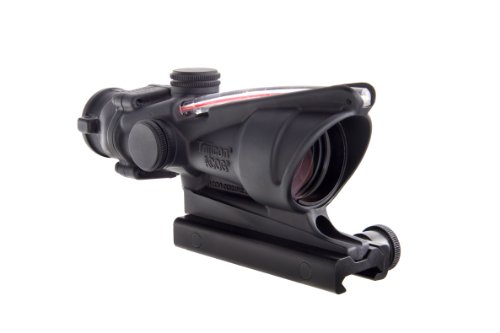
Trijicon ACOG 4×32 TA31F
- Best for: A hard-use carbine that has to stay ready with no battery checks.
- Magnification: 4x fixed
- Objective lens: 32 mm
- Reticle: Chevron, calibrated for .223/5.56
- Illumination: Fiber optics and tritium, no battery
A hard-use carbine that has to stay ready with no battery checks.
Eye relief is only 1.5 in, so confirm your stock length and mount position give a full picture without crowding the ocular lens.
Nearly every optic in this category copies the ACOG formula, and the TA31F is the original: a forged housing, a chevron reticle lit by fiber optics in daylight and tritium after dark, and no battery to check, ever. It suits the carbine that lives in a rack or a truck and has to work the moment it is picked up, with BDC marks drawn for 5.56 flattop rifles. The cost of that toughness is the shortest eye relief here, so it rewards a consistent cheek weld and a practiced mount.
Monstrum Cyborg 4X Prism Scope
- Best for: Lightweight carbines where a short, compact optic matters more than a wide view.
- Magnification: 4x fixed
- Reticle: Etched glass BDC, illuminated
- Field of view: 27.9 ft at 100 yards
- Mount: Picatinny
Lightweight carbines where a short, compact optic matters more than a wide view.
The 27.9 ft field of view is narrow for a 4x, and the Cyborg line ships in several powers, so confirm the 4X BDC variant on the listing before ordering.
Monstrum built the Cyborg line around a shortened prism assembly, and the listing describes this 4X body as 27 percent shorter and 23 percent lighter than the brand’s earlier prism scopes. What remains is a compact fixed 4x with an etched BDC reticle that lights up for low contrast targets. It fits lightweight carbines and compact builds where a full-size prism feels top-heavy, and the etched reticle stays crisp for shooters whose eyes smear a projected dot. The trade is a narrower field of view than the 32 mm scopes in this group.
CVLIFE 4×32 Prism Scope
- Best for: A training or range rifle where tri-color illumination helps new shooters.
- Magnification: 4x fixed
- Objective lens: 32 mm
- Reticle: Circle Dot, glass etched
- Illumination: Red, green and blue, 3 brightness levels per color
A training or range rifle where tri-color illumination helps new shooters.
Illumination runs on a coin cell, so carry a spare and learn the etched reticle with the power off.
This CVLIFE pairs a glass-etched circle dot reticle with illumination in red, green and blue, three brightness levels per color, and a fiber optic sight on top for close, fast shots. That mix suits a first prism scope on a training rifle: new shooters can pick the reticle color that stands out against their range backdrop, and the etched circle dot still works with the power off. The 32 mm objective and 36.6 ft field of view match the ACOG class on paper, in a cast aluminum body at the value end of this group.
Ozark Armament 4×32 Prism Scope
- Best for: Shooters who want an ACOG-style sight picture with more forgiving eye relief.
- Magnification: 4x fixed
- Objective lens: 32 mm
- Reticle: BDC with holdover marks from 100 to 600 yards
- Illumination: Red, green and blue, 3 settings per color
Shooters who want an ACOG-style sight picture with more forgiving eye relief.
Read the listing’s water resistance wording closely before trusting this optic in wet weather.
Ozark’s 4×32 follows the classic ACOG outline, built-in mount and all, but stretches eye relief to 3.5 inches, the most forgiving figure in this group. Its BDC reticle carries holdover marks from 100 to 600 yards and lights in red, green or blue with three settings per color. That suits shooters who want the familiar combat-scope layout on a hunting or general-purpose AR without pressing their eye close to the ocular. The all-metal body and integral mount keep the setup simple: one unit, clamped straight onto the rail.
Which One Fits Your Situation
A Carbine That Must Work After Years in the Rack
Pick the Trijicon ACOG TA31F. Fiber optics and tritium light the chevron with no battery to fade, leak or forget, and the forged housing shrugs off the knocks of a working gun. You give up brightness control and accept tight eye relief, but for a rifle whose whole job is readiness, nothing else in this group asks so little of you between range trips.
A Lightweight Build You Carry All Day
Pick the Monstrum Cyborg 4X. The shortened prism body trims both length and weight at the top of the receiver, which is where extra ounces feel worst on a long carry. The etched BDC reticle still gives holdover points for field shots, and illumination helps when a target sits in shadow. Just accept the narrower field of view that comes with the compact glass.
A First Prism Scope for a Training Rifle
Pick the CVLIFE 4×32. Three reticle colors with three brightness levels each let an instructor match the sight picture to the backdrop and the shooter, and the fiber optic sight on top covers close drills while the student learns the magnified view. When the coin cell fades mid-session, the etched circle dot carries on in black, so the lesson never stops for a battery hunt.
A Classic Layout With Room Behind the Ocular
Pick the Ozark Armament 4×32. Its 3.5 inches of eye relief is more than double the ACOG figure, which helps shooters with longer stocks, heavier recoil, or a head position that never quite matched a tight eyebox. You still get the familiar outline, a built-in mount and BDC marks to 600 yards, in an all-metal body that clamps on in one step.
Common Mistakes
- Buying a fixed 4x prism for room-clearing speed, then finding the magnification and tight eyebox slow down close work that a dot sight handles better.
- Mounting the scope too far forward for its eye relief, so the picture vignettes and every shot begins with a head shuffle.
- Trusting BDC holdover marks without confirming which caliber and load the marks were drawn for on the listing.
- Leaving battery illumination switched on in the safe, then meeting a dim reticle at the range and having no spare cell.
- Expecting a wide, binocular-like view from a compact prism body, when a narrow field of view is the normal cost of the small housing.
Frequently Asked Questions
Is a 4x prism scope the same as a red dot sight?
No. A red dot projects a single point onto a lens at 1x, with generous eye relief and no fixed eye position. A prism scope magnifies through a glass prism, carries an etched reticle with holdover marks, and asks your eye to sit at a set distance behind it. The prism is sharper and reaches farther; the dot is faster and more forgiving up close.
Can a prism scope help if a dot looks smeared?
Often, yes. A projected dot can bloom into a burst or comma shape for eyes with astigmatism, while an etched reticle is a physical pattern in glass that the eye focuses like print. Prism scopes also carry a diopter ring to tune focus for your eye. The four picks here all use etched reticles, which is the main reason dot shooters with smeared aiming points move to this format.
Does a prism scope still work when the battery dies?
Yes, in the way that matters. The reticle is etched into the glass, so with the power off or the cell removed you still see the full pattern in black against the target. You lose the glow that helps against dark backgrounds, nothing more. The ACOG in this group needs no battery at all, since fiber optics and tritium light its chevron in day and night conditions.
How far can you shoot with a fixed 4x?
Farther than most expect. Four power is enough to identify and hold on a torso-size target at several hundred yards, and the BDC marks on these reticles run to 600 yards on the Ozark and 800 meters on the ACOG chevron. The limit is target size and your hold, not the glass: small varmints and paper scoring rings ask for more magnification than any fixed 4x gives.