
Key takeaways
- Fuse the positive lead per the maker’s table and keep fuse holders away from standing water.
- Use tinned marine wire and sealed connectors in damp locations, and follow the manual’s wiring diagram.
- Mount the pump low where water collects, with the discharge hose running uphill to a through-hull fitting placed above the water line where the manual specifies.
- Use a one-way check valve only if the manual says to, since it can hold water in the line.
- For automatic pumps, test the float movement as the manual describes, and keep the bilge free of debris that can jam it.
- For work on a vehicle, boat or building electrical system beyond a simple fused connection, follow applicable code and consult a qualified electrician.
For high-volume water movement from a 12-volt battery, such as emptying a bilge, a shower sump or a small tank, a submersible centrifugal-style pump from a marine maker like Rule or Attwood is the practical answer, and the right one is chosen by gallons per hour, amp draw and fuse size rather than by pressure. If you need to build pressure for taps or spraying, a diaphragm pump is the better tool, and this guide explains where the line falls.
Our top picks


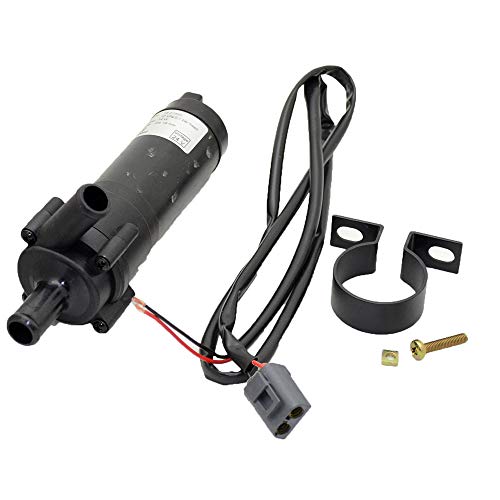
As an Amazon Associate we earn from qualifying purchases at no extra cost to you.
What a 12-volt centrifugal pump is good at
A centrifugal pump spins an impeller to fling water outward, which moves a lot of water at low pressure. Run from a 12-volt DC supply, it is the standard design for bilge pumps, livewell and shower sump pumps, battery-powered transfer jobs, solar fountains and emergency drainage. Its strengths are high flow for its size, simple construction and tolerance for small debris. Its weaknesses are modest head (lift) and poor ability to build pressure against a closed line; it does not self-prime well unless designed for it, which is why many are submersible.
That difference defines what to buy. Choose centrifugal for volume and diaphragm for pressure. Makers rarely publish a full head curve for small bilge units, so published figures are usually flow at zero or low head, and real output at a vertical lift or through long hose will be lower.
Confirmed models and stated specs
Rule standard bilge pumps
Xylem’s Rule model tables list non-automatic 12-volt pumps: the 24DA at 360 GPH drawing 2.1 amps on a 4 amp fuse, the 25DA at 500 GPH drawing 1.6 amps on a 4 amp fuse, and the 20DA at 800 GPH drawing 3.4 amps on a 7.5 amp fuse. These use a three-quarter-inch hose. The automatic 25SA is listed at 500 GPH, drawing 1.6 amps at 12 volts and 1.8 amps at 13.6 volts, the same fuse and draw as the 25DA. For larger volume, Rule lists the 13A and 14A at 3,700 GPH and the 56D at 4,000 GPH, drawing 15.5 amps at 12 volts and using a 25 amp fuse.
Attwood pumps
Attwood’s site lists the Tsunami T500, a 500 GPH, 12-volt bilge pump with a three-quarter-inch hose connection and 29-inch leads on the manual Mk2 version. Listings show about 1.7 amps and a 3 amp fuse size, and one retailer notes the 500 GPH rating is at 13.6 volts, with about 450 GPH at a nominal 12 volts. Attwood also sells a 12-volt shower sump system rated at 500 GPH. No head or pressure curves were available for these pumps, so those figures are omitted.
At a glance
| Pump | Rated flow | Stated draw | Fuse (maker) | Best for |
|---|---|---|---|---|
| Rule 24DA | 360 GPH | 2.1 A | 4 A | Small boats and light-duty bilge use |
| Rule 25DA | 500 GPH | 1.6 A | 4 A | Low-current 500 GPH needs |
| Rule 20DA | 800 GPH | 3.4 A | 7.5 A | More volume from a small pump |
| Rule 25SA (automatic) | 500 GPH | 1.6 A at 12 V | 4 A | Unattended bilge duty |
| Rule 56D / 13A / 14A | 4,000 GPH (56D); 3,700 GPH (13A, 14A) | 15.5 A at 12 V | 25 A | Large flow, bigger boats or tanks |
| Attwood Tsunami T500 | 500 GPH (at 13.6 V per one retailer) | About 1.7 A per listings | 3 A on the Mk2 manual version | General 12-volt bilge pumping |
| Attwood shower sump system | 500 GPH | Not listed | Per the manual | Draining a shower or sink sump on a boat or camper |
How to choose
Flow in gallons per hour
GPH figures are generally measured with no lift. A pump rated at 500 GPH will not deliver that at several feet of head or through a restrictive hose. Choose a rating well above the flow you need, and shorten the hose run and avoid sharp bends.
Amp draw and wiring
Match wire gauge and fuse to the draw. The Rule 25DA draws 1.6 amps for 500 GPH while the 20DA draws 3.4 amps for 800 GPH, so efficiency differs between models. A large pump drawing 15.5 amps needs a heavier cable and a proper fuse near the battery. Voltage drop along a thin cable reduces flow, so low battery voltage will affect performance.
Automatic versus manual
An automatic pump contains a float or sensor that turns it on when water rises. It adds convenience and a small standby draw. A manual pump needs a separate switch, which can be a panel switch or a float switch. Boats commonly use both, with a manual override on an automatic bilge system.
Water type and duty
Marine bilge pumps are built for fresh and salt water and for intermittent duty, not continuous running. A pump used as a continuous transfer pump may overheat. If you plan sustained transfer, look for a pump the maker states is continuous-duty.
Budget, mid-range and premium
Budget bilge pumps give the basics with shorter leads and no extras. Mid-range brands like Rule and Attwood publish model tables, hose sizes, fuse ratings and amp draws, making them easier to wire correctly. Premium adds larger-capacity pumps, heavy-duty construction and features like built-in float switches and strainer bases. A small boat or camper rarely needs more than mid-range.
Installation and safety
- Fuse the positive lead per the maker’s table and keep fuse holders away from standing water.
- Use tinned marine wire and sealed connectors in damp locations, and follow the manual’s wiring diagram.
- Mount the pump low where water collects, with the discharge hose running uphill to a through-hull fitting placed above the water line where the manual specifies.
- Use a one-way check valve only if the manual says to, since it can hold water in the line.
- For automatic pumps, test the float movement as the manual describes, and keep the bilge free of debris that can jam it.
- For work on a vehicle, boat or building electrical system beyond a simple fused connection, follow applicable code and consult a qualified electrician.
A bilge pump is not a substitute for fixing a leak and should not be relied on as the only protection against sinking or flooding. Keep a manual backup, such as a hand pump or bucket, on a boat.
Pick X if
| If you need | Pick |
|---|---|
| Smallest, lowest-current bilge pump | Rule 25DA |
| Hands-off protection on a small boat | Rule 25SA automatic |
| More volume from a compact pump | Rule 20DA |
| Large-volume emptying | Rule 56D, 13A or 14A with heavy wiring |
| Draining a shower or sink sump | Attwood shower sump system |
| Pressure for taps or spray | A diaphragm pump instead |
Alternatives
A 12-volt diaphragm pump suits pressurized water supply. A 120-volt utility or sump pump moves more water if mains power is available. A manual bilge pump costs nothing to run and works when the battery is dead. For garden or pond use, solar fountain pumps are designed for continuous low-flow duty.
Battery and power considerations
A pump is only as capable as the electrical system behind it. A pump drawing 15.5 amps for an hour consumes a meaningful share of a small battery, so large pumps suit boats with a proper house bank and charging source. Low-current pumps such as the 1.6 amp unit listed in the table suit small campers, trailers and portable battery boxes. Voltage matters as well, since a sagging battery can cut flow before it fully dies. A battery switch, a fused distribution panel and clean terminals make the system more reliable. If you plan a solar charger to keep the battery topped up, follow the charger’s manual. Keep connectors above the likely waterline, and label the pump circuit so that anyone aboard can find the switch quickly.
Frequently Asked Questions
Is a bilge pump a centrifugal pump?
Most 12-volt bilge pumps use an impeller design that behaves like a centrifugal pump, moving high volume at low pressure. Makers do not always use the word, so rely on the flow rating and the manual.
How many gallons per hour do I need?
Size above the flow you expect to remove, and allow for lift and hose losses. Listed GPH figures are typically at no lift, so real flow is lower.
What fuse should I use?
Use the maker’s stated fuse. Rule lists 4 amps for the 24DA and 25DA, 7.5 amps for the 20DA and 25 amps for the larger 56D, 13A and 14A.
Can a 12-volt centrifugal pump build water pressure?
Not well. It moves volume at low pressure. A diaphragm pump is designed to build pressure for taps and spray.
Can I run it from a car battery?
Yes if the pump is rated for 12 volts DC and wired with a correct fuse and wire gauge. Avoid draining the starting battery completely.
How long does a small pump last?
Life figures are not something to rely on from a spec sheet. Actual life depends on how often it runs and on debris and heat.
