
Key takeaways
- Know your pipe. Measure the main line and note whether it is copper, PEX, CPVC or galvanised steel. Fittings and adapters differ, and the connection standard for each product above is not the same.
- Location. All three makers place the device after the meter and on the cold supply. Leave the straight-pipe lengths the maker’s sheet specifies.
- Pressure. Compare your static pressure with the maker’s recommended range. If it is high, a pressure regulating valve is the usual solution and should be fitted upstream, not by guesswork.
- Power. Plan a nearby outlet. Where the outlet is unprotected in a damp basement, a GFCI outlet is the sensible choice, and Phyn specifically recommends one. If a new outlet is needed, that is a job for a licensed electrician; follow the manual and local code.
- Plumbing work. Cutting into the main line is plumbing work. Where local rules require a licensed plumber, hire one. Use only parts the maker lists and follow the manual.
- Wi-Fi. The Moen unit specifies 2.4 GHz. Check the signal at the main shutoff location, which is often a basement corner with poor coverage.
For most households, the best automatic water cut off valve is a whole-home smart shutoff that clamps onto the main line after the meter: the Moen Flo Shutoff suits buyers who want a mainstream, widely sold unit in several pipe sizes, the Phyn Plus (2nd generation) suits people who want a compact valve with a learning-based auto shutoff, and the GROHE Sense Guard suits European-style plumbing with 1 inch connections. In this guide, “automatic water cut off valve” means a motorised valve on the main supply that closes by itself when a leak or abnormal flow is detected. It does not mean the float valve in a toilet tank or a simple manual ball valve, although those are covered briefly in the alternatives section.
Our top picks

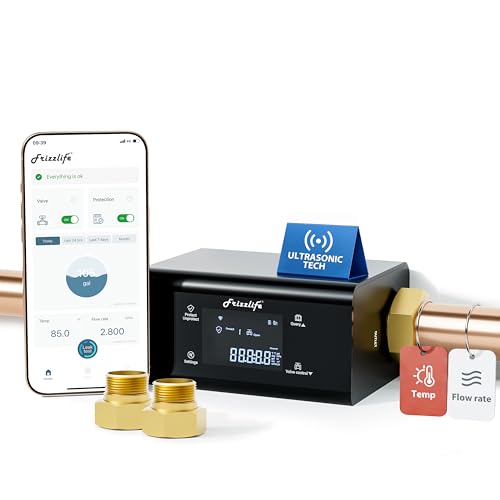


As an Amazon Associate we earn from qualifying purchases at no extra cost to you.
What an automatic shutoff valve actually does
A manual main shutoff only helps if someone is home and knows where it is. A motorised shutoff valve adds a flow sensor, a controller and a valve body to the main line. When flow looks wrong, for example water running steadily for hours while nobody is home, the controller closes the valve and sends a phone alert. Some models also learn normal household habits, and some accept signals from separate puddle sensors placed under sinks, water heaters and washing machines.
It is worth being realistic about what these devices are. They reduce the time a leak can run, but they do not stop a pipe from failing, and no maker promises they prevent damage. They depend on power, Wi-Fi and correct installation. A valve that cannot be powered, for instance, may not be able to close, which is a real design point covered below.
At a glance: the main options
| Product | Best for | Key stated specs | Limits |
|---|---|---|---|
| Moen Flo Shutoff (formerly Flo Smart Water Monitor and Shutoff) | Homes wanting a mainstream unit with size choices | Sold in 3/4 inch (model 900-001), 1 inch (900-006) and 1-1/4 inch (900-002) versions; maximum operating pressure 175 psi, with the installation sheet recommending 80 psi continuous; needs 2.4 GHz Wi-Fi and an outlet within 10 feet | Pipe-size compatibility wording differs between Moen pages for the largest unit; needs straight pipe clearance around the body; cold main line only |
| Phyn Plus Smart Water Assistant + Shutoff (2nd Gen) | Tight spaces and buyers who want learned auto shutoff and optional sensor triggers | Recommended for pipes no larger than 1-1/4 inch; 1 inch NPSM male threaded ends; 12 foot power cord included; Wi-Fi required; one account can monitor up to 6 properties | Thread adapters are not included; auto shutoff is off by default while it learns usage; outlet within 12 feet, GFCI recommended |
| GROHE Sense Guard | Single-family homes with metric-style plumbing | 1 inch connections with 3/4 inch mounting connections; flow range 2 to 85 litres per minute; maximum operating pressure 1 MPa; water and ambient temperature 3 to 40 degrees C; 12 V DC supply | Cannot shut off water without power; cold water pipes only; intended for single-family houses |
Figures above come from the makers’ own pages. Where pages disagree, this guide says so.
Moen Flo Shutoff
The Moen Flo Shutoff is offered in three body sizes. The maker lists the 3/4 inch model as 900-001, the 1 inch model as 900-006 and the 1-1/4 inch model as 900-002. The smaller two are described as compatible with 3/4 inch or smaller and 1 inch or smaller pipe respectively. The largest model has 1-1/4 inch connections, but listings differ on its stated pipe range: Moen’s page gives both 1-1/4 inch or smaller and 1-1/2 inch or smaller. Because of that conflict, read the model-specific spec sheet before choosing the largest size, and match the unit to the actual pipe outside diameter and material in the basement or utility room.
The maker states a maximum operating pressure of 175 psi, while the installation sheet recommends a maximum continuous pressure of 80 psi. Those two numbers are not contradictory: one is a rating limit and the other is a design target. If a home runs high street pressure, a pressure regulating valve upstream is the normal fix, and Moen states the unit must be installed after the water meter, the water shut-off and the pressure regulating valve where one exists. It goes on the cold water main line.
Power and connectivity are straightforward. The unit needs 2.4 GHz Wi-Fi, a smartphone with the app, and an AC outlet within 10 feet. Longer extension cables are sold separately by the maker. The installation sheet gives clearance dimensions: for the 900-001 and 900-006 roughly 6 inches above the body, 4 inches of straight pipe on the inlet and 2 inches on the outlet, with a larger envelope for the 900-002. Use the printed sheet from the box before cutting any pipe.
Phyn Plus (2nd generation)
Phyn describes the second-generation Plus as smaller than the original, and its enclosure is intended for indoor or outdoor mounting. The maker recommends installing it on pipes no larger than 1-1/4 inch. Its connections are 1 inch NPSM male threaded ends, and adapters are not included, so a plumber or an informed DIY buyer will often need a 1 inch NPS-to-NPT adapter that matches the existing pipe. A 12 foot power cord is included, and Phyn recommends a GFCI outlet within 12 feet of the install location.
Two behaviours matter. First, the valve stays in whatever state it was in when power was lost. It will not close during an outage unless it was already closed, but the bracket has a manual shutoff tool so the valve can be opened or closed by hand. Second, Auto Shutoff is disabled by default while the device learns the home’s usage pattern. When it triggers, the app sends an alert, and if nobody responds within the time window the device closes the valve. Phyn smart water sensors can also be configured to trigger the shutoff when they detect water. You can also operate the valve from the app or by holding the blue button on the unit for three seconds.
The product is a fit for buyers who want one account to cover more than one building, since the maker says up to six properties can be monitored on a single account.
GROHE Sense Guard
GROHE’s smart water controller is aimed at single-family houses and is installed right after the water meter on cold water pipes. The maker lists 1 inch connections with 3/4 inch mounting connections, and a wall mounting set with a G1 inch connection is recommended separately. The technical data sheet gives a flow range of 2 to 85 litres per minute, a maximum operating pressure of 1 MPa, a test pressure of 1.6 MPa, and a recommended working pressure between 0.1 and 0.5 MPa. Water and ambient temperature are both listed as 3 to 40 degrees C, which makes it a poor choice for an unheated outbuilding in winter.
It runs from a 12 V DC supply rated 2.5 A, about 30 W. The maker states that without power it cannot shut off the water supply. That is an honest limitation to weigh against valves that have a manual override, and it is a reason to put the unit on a socket that is not shared with something regularly unplugged.
Compatibility and installation notes
- Know your pipe. Measure the main line and note whether it is copper, PEX, CPVC or galvanised steel. Fittings and adapters differ, and the connection standard for each product above is not the same.
- Location. All three makers place the device after the meter and on the cold supply. Leave the straight-pipe lengths the maker’s sheet specifies.
- Pressure. Compare your static pressure with the maker’s recommended range. If it is high, a pressure regulating valve is the usual solution and should be fitted upstream, not by guesswork.
- Power. Plan a nearby outlet. Where the outlet is unprotected in a damp basement, a GFCI outlet is the sensible choice, and Phyn specifically recommends one. If a new outlet is needed, that is a job for a licensed electrician; follow the manual and local code.
- Plumbing work. Cutting into the main line is plumbing work. Where local rules require a licensed plumber, hire one. Use only parts the maker lists and follow the manual.
- Wi-Fi. The Moen unit specifies 2.4 GHz. Check the signal at the main shutoff location, which is often a basement corner with poor coverage.
Budget tiers
All three smart valves sit in the mid-range to premium tiers, and bundles with sensors or a protection service push toward premium. A budget approach is to skip the smart valve and use stand-alone leak alarms plus a labelled, easy-to-reach manual shutoff, which protects nothing while you are away. Some buyers start with a valve and add puddle sensors later, which the Phyn and Moen systems both support.
Pick X if you
| Pick this | If you |
|---|---|
| Moen Flo Shutoff | want a size-matched body (3/4, 1 or 1-1/4 inch listed) and are comfortable following the installation sheet’s clearance table |
| Phyn Plus 2nd Gen | have limited wall space, want the manual override tool on the bracket, or manage more than one property from one account |
| GROHE Sense Guard | have 1 inch metric-style connections and a single-family home, and can keep the unit on a reliable power supply |
| A plain manual main valve plus stand-alone alarms | want the lowest cost and are usually home, accepting there is no automatic closing |
Alternatives to consider
Appliance-level flood stops
Washing-machine hoses with built-in shutoff devices protect a single appliance and need no Wi-Fi.
Stand-alone leak sensors
Battery sensors that sound an alarm are the simplest early warning. They do not close any valve, so they only help if someone hears them.
Solenoid valves with a controller
Hobbyist or building-automation setups pair a motorised valve with a separate leak controller. These can be flexible, but compatibility, ratings for potable water and electrical safety then fall on the installer. Use only equipment the maker lists for potable water and have mains wiring done by a licensed electrician.
Frequently Asked Questions
Will an automatic shutoff valve prevent a burst pipe?
No. It can close the supply after it detects abnormal flow, which may limit how much water escapes, but makers do not claim it stops a pipe from failing. Insulating exposed pipes and keeping the house heated in cold weather are still the real preventive steps.
Can I install one myself?
The valve goes into the main supply line, which is plumbing work. Handy owners with the right fittings do it, but many jurisdictions require a licensed plumber for work on the main, and any new outlet should be installed by a licensed electrician. Follow the maker’s manual and local code.
What happens during a power cut or Wi-Fi outage?
It depends on the model. Phyn states the valve stays in its last state and offers a manual tool on the bracket. GROHE states the unit cannot shut off the water without power. Moen requires an AC outlet and Wi-Fi for its smart features, so read its manual for outage behaviour.
Which pipe size do I need?
Measure the main line and match it to the model. Moen lists 3/4 and 1 inch units plus a 1-1/4 inch unit whose stated pipe range differs between listings, Phyn recommends pipes no larger than 1-1/4 inch with 1 inch NPSM ends, and GROHE lists 1 inch connections.
Do I need a subscription?
Some makers sell protection services or monitoring plans as optional extras, and bundles may include them. Read the plan terms for each product, since the basic valve and app are separate from any paid service.
Can it go on a hot water line or an outdoor line?
Moen and GROHE state cold-water main installation. GROHE lists an ambient temperature of 3 to 40 degrees C, so an unheated or freezing location is outside its stated range. Phyn describes its enclosure as suitable for indoor or outdoor use, but follow the manual for the location.
