
Key takeaways
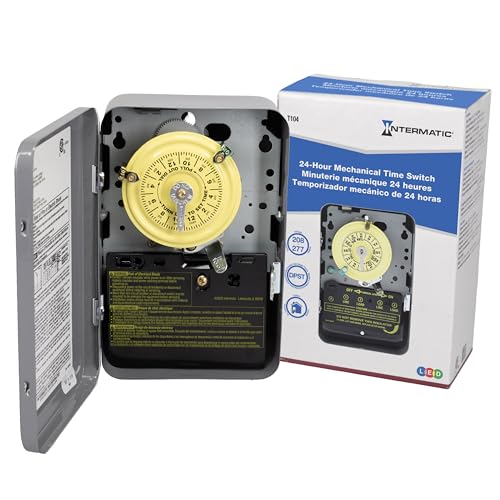
- T104: 24-hour, 208 to 277 VAC, 60 Hz, double-pole single-throw, indoor metal enclosure, with a 40 amp capacity, a one-hour interval and a manual override.
- T104R: the same switch in an indoor/outdoor metal enclosure; the enclosure is listed as Type 3R.
- Shared ratings: up to 12 on/off operations per day with a minimum on or off time of one hour; one ON and one OFF tripper included; motor load rated 2 HP (24 FLA) at 120 VAC and 5 HP (28 FLA) at 240 VAC; wire size accepted is number 14 to number 8 AWG.
- T104R201: adds pool heater protection (a fireman’s switch) in a Type 3R metal enclosure.
- T104R3: a beige Type 3R metal enclosure.
- T104P and T104P3: plastic-enclosure versions; T104M is the mechanism only.
For a typical in-ground pool, the most widely used pool pump timer is Intermatic’s T100-series 24-hour mechanical time switch, with the T104R (outdoor-rated metal enclosure) the usual pick for an equipment pad and the T104 for a dry indoor location. Owners who want a plain schedule with no app and no batteries get a simple, repairable device. Before buying, check your pump voltage, whether the pump is 120 or 240 volts, and who is going to wire it, because a pool timer is mains-voltage equipment.
Our top picks

As an Amazon Associate we earn from qualifying purchases at no extra cost to you.
What a pool pump timer does
A pool pump timer switches the filter pump on and off at set times so the water is filtered and circulated daily without anyone touching a switch. The common mechanical type is a 24-hour dial driven by a small clock motor. Pins or “trippers” on the dial set the on and off times, and a manual lever lets you override the schedule. Newer digital and app-controlled options exist, but mechanical dials remain popular because they are simple, have no firmware, and can be replaced by a pool technician in minutes.
A correct run time depends on the pump size, pool volume and local conditions, and the pool or pump maker’s manual is the best source. Do not treat any timer as a guarantee of water quality; it only controls when the pump runs.
The Intermatic T100 family
Intermatic lists the T104 and T104R as 24-hour mechanical time switches from its T100 series, with the only difference being the enclosure. According to the maker:
- T104: 24-hour, 208 to 277 VAC, 60 Hz, double-pole single-throw, indoor metal enclosure, with a 40 amp capacity, a one-hour interval and a manual override.
- T104R: the same switch in an indoor/outdoor metal enclosure; the enclosure is listed as Type 3R.
- Shared ratings: up to 12 on/off operations per day with a minimum on or off time of one hour; one ON and one OFF tripper included; motor load rated 2 HP (24 FLA) at 120 VAC and 5 HP (28 FLA) at 240 VAC; wire size accepted is number 14 to number 8 AWG.
- T104R201: adds pool heater protection (a fireman’s switch) in a Type 3R metal enclosure.
- T104R3: a beige Type 3R metal enclosure.
- T104P and T104P3: plastic-enclosure versions; T104M is the mechanism only.
Intermatic also lists a support article on telling T100-series models apart, which is worth reading because the numbers differ by voltage and pole count, and the wrong voltage version is a common mistake.
At a glance
| Model | Enclosure | Key stated specs | Best for | Limits |
|---|---|---|---|---|
| Intermatic T104 | Indoor metal | 24-hour; 208 to 277 VAC; DPST; 40 A; manual override | Sheltered equipment room | Not for outdoor exposure |
| Intermatic T104R | Type 3R metal, indoor/outdoor | Same switch as T104 | Pool equipment pad | Mechanical dial, 1-hour minimum interval |
| Intermatic T104R201 | Type 3R metal | Adds heater protection (fireman’s switch) | Pools with a heater | Confirm heater wiring with the heater manual |
| Intermatic T104R3 | Type 3R, beige metal | Same switch, beige case | Visual match | Same limits |
| Intermatic T104P / T104P3 | Plastic | Plastic enclosure versions | Corrosive air near salt water | Confirm ratings in the maker’s sheet |
Voltage, poles and load: matching the timer to the pump
The T104 family is listed for 208 to 277 VAC, so it matches 240-volt pumps. A 120-volt pump needs a timer with a 120-volt clock motor. Intermatic’s support table lists the T101 (single pole) and T103 (double pole) as 120 VAC models in the same series, but confirm the exact model and contact rating on the maker’s sheet before buying. The listed motor ratings (2 HP at 120 VAC and 5 HP at 240 VAC) are the ceiling for the load. A pump’s nameplate shows its voltage and full-load amps, and the timer rating must exceed that.
Two-pole switching matters at 240 volts because it opens both hot legs when the timer turns the pump off. Single-pole timers leave one leg live and are not appropriate for a 240-volt pump unless the manual says so. Variable-speed pumps are a special case. Many have their own built-in scheduling. Pentair’s variable-speed installation guide says these pumps need continuous power and that repeatedly cycling power can damage the motor, and a Hayward guide says a pump previously on a time clock should be connected directly to line power. Read the pump manual before adding a timer to a variable-speed pump, and use the pump’s own schedule or an automation relay input.
Features that matter
- Manual override: lets you run the pump for a service or to shock the pool without disturbing the schedule.
- Heater protection: a fireman’s switch delays the pump shut-off after the heater turns off so the heater is not left hot without water flow. It only does this if wired per the heater maker’s instructions.
- Interval: a one-hour minimum on/off step is fine for filtering schedules but not for short boosts.
- Enclosure: Type 3R is rated against falling rain and sleet, not submersion. Mount where the manual says and keep it above splash.
- Power outage behavior: mechanical clocks lose time during an outage unless backed up, so the schedule shifts until reset.
Mechanical, digital or app-controlled
Mechanical dials are cheap, simple and long-lived. Digital timers add multiple programs and are easier to read. Smart pool controllers add schedules by sunrise and sunset, phone control and remote alerts, and they usually cost more and may require a technician to configure. For budget tiers, a basic mechanical dial is the entry level, digital in-wall or box timers are mid-range, and automation controllers are premium. Pick the tier that your comfort level and the pool equipment can support. If the controller lists compatibility with a specific pump brand, make sure yours is on it.
Installation and safety
This is mains wiring, usually 240 volts, around water. Follow the timer’s instructions and local electrical code, and hire a licensed electrician for hardwired work. Pool equipment typically requires bonding and ground-fault protection under code, and local rules vary. Never defeat a ground-fault device, bypass a breaker, or open the timer enclosure with power on. Use only listed equipment as the maker states, and do not rely on a timer, or any switch, to prevent accidents. Keep children away from equipment pads, and keep enclosures closed.
Pick X if
| If you want | Pick |
|---|---|
| Outdoor equipment pad, 240 V pump, simple schedule | Intermatic T104R |
| Dry indoor equipment room | Intermatic T104 |
| Pool with a gas or electric heater | Intermatic T104R201 (heater protection) |
| Corrosive or salt-laden air | Plastic enclosure variants, per maker data |
| Phone control and scheduling by sunrise | A pool automation controller |
Alternatives
A variable-speed pump with a built-in schedule can replace an external timer altogether, and the pump maker’s manual describes the setup. A pool automation panel from a pool equipment brand can handle pump, heater, lights and valves together. For lightly used above-ground pools with a 120-volt pump, a plug-in outdoor mechanical timer rated for the pump’s current may suit, provided the pump’s amps are under the timer’s rating and the maker’s instructions allow it.
Setting up the schedule sensibly
Once the timer is wired and inspected, the schedule is where most owners spend their thought. Many pool owners split the run into one or two blocks, often during daylight when the water is warmest and in line with any off-peak electricity rules from their utility. The one-hour minimum interval on the T100 series means trippers are set in whole-hour steps, which is fine for a daily filter run. If you add a heater, make sure the pump runs before the heater is allowed to fire and keeps running afterward as the heater maker’s manual describes. Seasonal changes matter, since summer sun and heavy use call for longer circulation than winter. Rather than guessing, ask the pool builder or a local service company for a starting schedule, then adjust to how the water looks. Replace worn trippers and keep the enclosure closed so insects and moisture stay out of the mechanism.
Frequently Asked Questions
What is the difference between the T104 and T104R?
According to Intermatic, they are the same 24-hour switch. The T104 has an indoor metal enclosure, while the T104R has an indoor/outdoor Type 3R metal enclosure.
Can I use a T104 on a 120-volt pump?
The T104 is listed for 208 to 277 VAC, so it is aimed at 240-volt pumps. For 120 volts, Intermatic’s support table lists the T101 (single pole) and T103 (double pole) in the same series; match the voltage and pole count to your pump and confirm on the maker’s sheet.
How many hours should a pool pump run?
It depends on the pool volume, pump flow, bather load and weather. The pool or pump maker’s manual and a local pool professional are the best guide. A timer only schedules the run.
What is a fireman’s switch?
It keeps the pump running briefly after the heater turns off so residual heat is carried away. Intermatic lists this on the T104R201, and it works only when wired as the heater manual specifies.
Can I wire a pool timer myself?
Because it is mains wiring near water, follow local code and use a licensed electrician where required. Do not defeat ground-fault or bonding protection.
Why is my timer running at the wrong time?
Mechanical clock motors stop during a power outage, so the dial falls behind. Reset the dial to the correct time and consider a battery-backed or digital timer if outages are common.
