
Key takeaways
- Cast iron body and impeller: better heat dissipation and wear resistance than thermoplastic, and the Zoeller high-head Flow-Mate series uses a cast iron body (sources differ on its impeller metal). Engineered plastic is lighter and cheaper but gives up some abrasion resistance.
- Second mechanical seal: the 4140 adds one over the 140, which can matter in continuous or harsh duty.
- Switch type: a piggyback float lets you test or replace the switch without changing the pump. Vertical floats suit narrow basins.
- Explosion-proof rated models: Zoeller lists X-series pumps (such as the X4161) rated for Class 1, Division 1 locations. They are for commercial or industrial settings, not ordinary homes.
- Check valve and vent hole: installation hardware that prevents backflow and airlock. Follow the manual for placement.
For household waste water, the right submersible pump depends on what is in the water: choose an effluent pump when the liquid is gray water or septic-tank effluent with small solids, a sewage pump with a two-inch solids rating when toilet waste is involved, and a grinder pump when the discharge line is small or the head is high. “Waste water submersible pump” is a broad phrase, so this guide sorts the pump types first and then names confirmed current models from makers such as Zoeller and Liberty.
Our top picks


As an Amazon Associate we earn from qualifying purchases at no extra cost to you.
Three kinds of pump hiding behind one keyword
Effluent pumps
Effluent pumps move relatively clear liquid from a septic tank outlet, a laundry or a bathroom sink and shower drain basin. They handle small solids only. Zoeller lists its Model 153 (half horsepower) with three-quarter-inch solids handling, heads up to 44 feet and flows up to 77 GPM on 115 or 230 volts (some retailer listings show lower maximums for the 115 volt version, so read the data sheet for your exact variant), with a one-and-a-half-inch NPT discharge. Its Model 140 and 4140 (one horsepower) are listed with half-inch solids handling, the 4140 adding a second mechanical seal.
Sewage pumps
Sewage pumps pass larger solids through a non-clogging vortex or wide-passage impeller. Zoeller lists its Model 267 (half horsepower) as passing two-inch spherical solids, delivering up to 115 GPM and 20.5 feet of head, with a two-inch NPT discharge and a choice of voltages. Liberty’s LE-Series (LE40, LE50 and LE70 at four-tenths, half and three-quarter horsepower) is also listed by the maker with two-inch solids handling.
Grinder pumps
A grinder pump chops solids so they can travel through a smaller pipe, useful for long runs and higher head. Liberty lists its ProVore as a one-horsepower grinder pump with a two-inch discharge, V-Slice cutter technology and cast iron construction, running on a standard 115 or 230 volt circuit with a 20 amp breaker. The maker lists flow up to 46 GPM and says it suits lower heads in residential basements, not three-inch discharge systems or high-head systems.
At a glance
| Pump | Type | Key stated specs | Best for | Limits |
|---|---|---|---|---|
| Zoeller Model 153 | Effluent | 1/2 HP; up to 44 ft head; up to 77 GPM; 3/4 in. solids; 1-1/2 in. NPT; 115 or 230 V; plastic impeller | Septic effluent, laundry and sink basins | Not for toilet waste |
| Zoeller Model 140 / 4140 | Effluent | 1 HP; 1/2 in. solids; 1-1/2 in. NPT; 115 or 230 V; 4140 adds a second seal | Higher output effluent jobs | Small solids only |
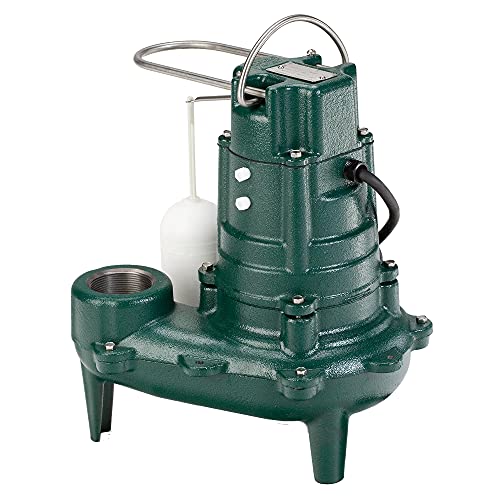
| Zoeller Flow-Mate 161 / 163 / 165 series | High-head effluent | Up to 86.5 ft head; up to 100 GPM; 130 F max; cast iron body; 3/4 in. solids; impeller material is listed differently by different sources | Longer or higher lifts | More expensive and more power |
| Zoeller Model 267 | Sewage | 1/2 HP; 2 in. solids; up to 115 GPM; 20.5 ft head; 2 in. NPT; 1725 RPM | Toilet waste to a nearby sewer | Modest head |
| Liberty LE40 / LE50 / LE70 | Sewage | 2 in. solids handling per the maker | Basement ejector pits | Confirm head curve for your lift |
| Liberty ProVore | Grinder | 1 HP; 2 in. discharge; up to 46 GPM; 115 or 230 V | Small discharge line | Not for 3 in. or high-head systems |
How to size the pump
Three numbers drive the decision: total head, flow and solids. Total head is the vertical lift from the pump to the highest point of the discharge, plus friction loss in the pipe. Every maker publishes a performance curve; use it rather than the single headline figure. The headline “up to” flow is usually at very low head, and real flow at your lift will be lower. The Zoeller Model 267, for instance, lists up to 115 GPM but only 20.5 feet of head, so it suits a short basement lift but not a long uphill run.
Solids rating is the second filter. A pump rated for three-quarter-inch solids is an effluent pump; it can clog on wipes or toilet paper in a sewage basin. If toilet waste enters the basin, the two-inch solids rating matters, and local plumbing code often requires it. Voltage and breaker size come third. A one-horsepower pump on 115 volts draws substantial current, so its circuit needs to follow the manual.
Features worth paying for
- Cast iron body and impeller: better heat dissipation and wear resistance than thermoplastic, and the Zoeller high-head Flow-Mate series uses a cast iron body (sources differ on its impeller metal). Engineered plastic is lighter and cheaper but gives up some abrasion resistance.
- Second mechanical seal: the 4140 adds one over the 140, which can matter in continuous or harsh duty.
- Switch type: a piggyback float lets you test or replace the switch without changing the pump. Vertical floats suit narrow basins.
- Explosion-proof rated models: Zoeller lists X-series pumps (such as the X4161) rated for Class 1, Division 1 locations. They are for commercial or industrial settings, not ordinary homes.
- Check valve and vent hole: installation hardware that prevents backflow and airlock. Follow the manual for placement.
Budget, mid-range and premium
Budget pumps tend to use plastic impellers and thermoplastic housings, adequate for light-duty effluent. Mid-range pumps in this guide’s lists, such as the Zoeller 153 and 267, give you recognized brand support and clear specs. Premium covers cast iron, double-seal and high-head series and grinder systems, which pay off when the pump runs often or must lift far. Because a failed waste pump causes a mess and possible damage, reliability usually matters more than saving on the first purchase.
Installation and safety notes
Basin size must match the pump: a combination system needs a basin of the diameter its manual specifies, and a pump crowded by the basin wall can jam its float. Pump basins for sewage need sealed lids and venting per local code. Electrical work should be on a dedicated, properly protected circuit with ground-fault protection where the local code calls for it, and hardwired work belongs to a licensed electrician. Never bypass or tape back a float switch, never run a pump dry for long, and disconnect power before reaching into a basin. Sewage gases are hazardous; ventilate and do not enter a closed pit.
Where a basement ejector is required, many jurisdictions require permits and inspection. Check what your local code says before replacing a unit, and follow the manufacturer’s instructions for pipe diameter, check valve orientation and venting.
Pick X if
| If your situation is | Pick |
|---|---|
| Septic tank effluent, small solids, modest lift | Zoeller Model 153 |
| Long or high lift of effluent | Zoeller Flow-Mate high-head series |
| Basement toilet waste to the sewer line | Zoeller Model 267 or Liberty LE-Series |
| Small-diameter discharge or longer run with waste solids | Liberty ProVore grinder |
| Hazardous location | Explosion-proof X-series, installed by a professional |
Alternatives
A utility pump is meant for clean or lightly dirty water, not waste. A sump pump with a half-inch solids limit suits groundwater, not sewage. A macerating toilet system is a self-contained option when adding a bathroom below the sewer line, and some owners prefer it for a single fixture. A plumber can advise which system suits your layout.
Maintenance and signs of trouble
A waste pump sits unseen for months, so a simple routine helps. Lift the basin lid on a schedule the maker’s manual suggests, check that the float moves freely, and confirm the pump starts and empties the basin when water is added, always disconnecting power before reaching into the pit. Warning signs include a pump that hums without moving water, runs far longer than it used to, trips its breaker, or cycles every few seconds. Those can point to a clogged impeller, a failed check valve, a worn seal or a stuck switch. Because sewage work involves biological hazards, many owners hand repairs to a plumber. Keep wipes, hygiene products, grease and rags out of the drain, since even a two-inch solids rating does not make a pump immune to rope-like blockages. Record the model number and the installation date so that replacement parts and warranty questions are easy to answer later.
Frequently Asked Questions
What is the difference between an effluent pump and a sewage pump?
An effluent pump handles liquid with small solids, such as septic tank outlet water. A sewage pump passes larger solids, with Zoeller listing two inches for its Model 267. Using an effluent pump on raw toilet waste risks clogging.
How many horsepower do I need?
Horsepower alone does not decide it. Read the performance curve to see flow at your total head. Half horsepower is common for residential basins, and one horsepower is listed for higher-output models.
Can I install a waste water pump myself?
Plumbing connections are within some owners’ skills, but hardwired electrical work should follow local code and a licensed electrician where required. Permits may apply to sewage ejectors.
Does a grinder pump replace a sewage pump?
It does the same job differently by cutting solids so they can pass through a smaller pipe. The maker lists the ProVore for lower heads and a two-inch discharge, so it is not a universal swap.
Why does my pump keep cycling or not switching off?
The float may be snagged on the basin wall, the check valve may be leaking back, or debris may be holding the switch. Disconnect power and follow the manual before inspecting.
How hot can the water be?
Zoeller lists 130 degrees Fahrenheit as the maximum operating temperature for its Flow-Mate series. Check the maker’s limit for any other model before connecting hot discharge.
