Key takeaways
- An old diesel pickup needs serious cold cranking amps and the right group size. Compare three proven batteries and learn what to check before you buy.
As an Amazon Associate we earn from qualifying purchases.
Affiliate Disclosure: This article contains affiliate links. If you buy through a link on this page, we may earn a commission at no extra cost to you.

An old diesel pickup is harder on a battery than almost any other vehicle in the driveway. A diesel has no spark plugs; it lights its fuel with compression alone, which means the starter has to spin a high-compression engine fast enough, against thick cold oil, while the glow plugs (or grid heater) are simultaneously pulling a heavy load off the same battery. Add twenty or thirty years of tired cables, corroded terminals and a starter that draws more than it did when new, and a battery that would happily start a gasoline truck will leave an old diesel clicking on the first cold morning of the year.
This guide covers what actually matters for an older diesel pickup — cold cranking amps, group size, reserve capacity and dual-battery discipline — and three batteries that fit the job. Specifications are taken from the manufacturers’ listings; we have not tested these batteries ourselves.
Why Old Diesel Pickups Kill Batteries
Three things stack up against you:
- Compression. Diesel engines run compression ratios roughly double those of gasoline engines. Cranking one takes sustained torque, not a brief spin, so the battery has to hold voltage under a heavy load for longer.
- Glow plugs. Before the starter even turns, the glow plug system pre-heats the cylinders and can draw substantial current for several seconds — longer in cold weather, and older systems often cycle more than once.
- Cold. Battery output falls as temperature drops, exactly when oil is thickest and cranking demand is highest. The rating that captures this is cold cranking amps (CCA): the current a battery can deliver at 0°F for 30 seconds while staying above a minimum voltage. For an old diesel, CCA is the first number to look at, and erring high is rarely a mistake.
Many older diesel pickups — the Ford Power Stroke, Dodge Cummins and GM Duramax and 6.5 trucks of the 1990s and 2000s — also run two batteries in parallel. If yours does, read the dual-battery section below before buying anything: replacing only one of a pair is the most common and most expensive mistake owners make.
Step One: Get the Group Size Right
Batteries are built to standardized BCI group sizes that define the case dimensions, terminal layout and hold-down style. Common sizes on older diesel pickups include Group 65 (many Ford trucks), Group 31 (heavy-duty and some Dodge applications, often with threaded posts), Group 27 and Group 78/34 combinations on GM trucks. Your owner’s manual, the label on the old battery, or the parts listing for your exact year and engine will tell you which size your truck takes.
Do not buy on CCA alone. A battery with a huge CCA figure in the wrong case will not fit the tray, the cables may not reach, and a terminal in the wrong position can short against the hold-down or hood. Confirm four things before ordering: group size, overall dimensions, terminal type (top post, side post, or both), and which side the positive terminal sits on.
Our Picks: 3 Batteries for an Older Diesel Pickup
1. Odyssey ODX-AGM65 Extreme Series — Maximum Cranking Power in Group 65
ASIN: N/A
The Odyssey ODX-AGM65 is the heavy hitter for trucks that take a Group 65 battery. Odyssey’s listings rate it at 930 CCA with 135 minutes of reserve capacity, and the manufacturer’s technical data sheet for the model describes an absorbed glass mat (AGM) design using thin plate pure lead (TPPL) plates, with a 74Ah nominal capacity at the 20-hour rate and tin-plated brass SAE posts. That combination — very high cranking output plus genuine deep-cycle tolerance — is exactly what an old diesel asks for: strong cranks, tolerance of the glow-plug draw, and the ability to recover from the occasional deep discharge when a truck sits for weeks between uses.
We list it as “ASIN: N/A” because we could not verify a current Amazon US listing for this exact model at the time of writing; it is widely sold through battery specialists and auto parts channels. If you buy through one of those, confirm the model number ODX-AGM65 on the case and check the manufacture date — a fresher battery is a better battery, whatever the brand.
Choose the Odyssey if your truck takes Group 65, you live where winters are serious, and you want the strongest listed cranking figure in this roundup.
2. WEIZE Platinum AGM Battery, BCI Group 65 — Strong Specs, Straightforward Value
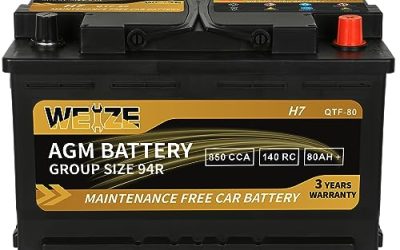
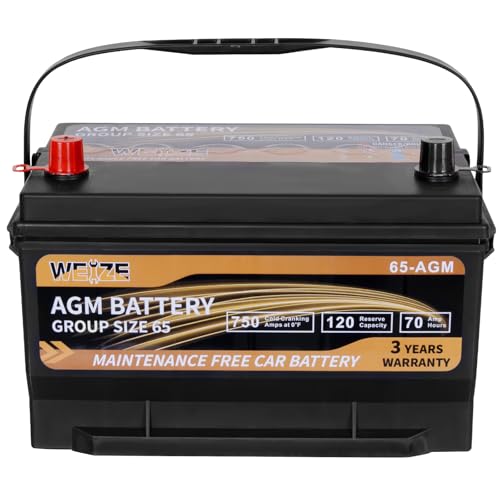
WEIZE’s Platinum AGM in Group 65 is listed at 12 volts, 70Ah capacity, 750 CCA and 120 minutes of reserve capacity, in a case measuring 12.05 x 7.56 x 7.56 inches with tapered terminals arranged positive-left, negative-right. The listing states a 36-month warranty and an operating temperature range from -22°F to 158°F, and describes the AGM construction as delivering up to twice the cycle life of a conventional flooded battery.
750 CCA is a step down from the Odyssey above, but it meets or exceeds the factory CCA specification of many older diesel trucks, and for a truck in a mild or moderate climate it is a sensible amount of cranking power. The AGM design also suits trucks that sit: AGM batteries self-discharge more slowly than flooded ones and there is no water level to check, which matters on a farm or second truck that may stand for a month and still be expected to start.
Choose the WEIZE if your truck takes Group 65, your winters are not extreme, and you want a sealed AGM battery with a clearly listed specification and warranty.
3. OPTIMA RedTop 34 Starting Battery — The Dual-Terminal Problem Solver
OPTIMA’s RedTop 34 (model 8002-002) is a sealed AGM starting battery built around OPTIMA’s spiral-wound cell design, rated at 800 CCA with 50Ah capacity. The listing gives its size as 10 x 6-7/8 x 7-13/16 inches with SAE top terminals. The RedTop line is OPTIMA’s starting-focused range — built to deliver a strong cranking burst and to tolerate vibration, which is a real factor in an old truck with worn mounts and rough-road use.
Why include a Group 34 in a diesel guide? Because a long life of previous owners means many old pickups no longer have their original battery configuration, and the RedTop family — especially the 34/78 variant with both top SAE and side GM terminals — is a common, proven fit in trucks whose cables have been changed over the years. The honest caveat: you must confirm that a Group 34 case and its terminal layout actually fit your truck’s tray and cables before choosing it over the correct group size, and on a dual-battery truck both batteries must match.
Choose the RedTop if your truck’s tray and cables suit a Group 34, you want 800 CCA in a compact, vibration-resistant case, or you need the dual-terminal flexibility of its 34/78 sibling (verify that variant’s listing separately).
Dual-Battery Trucks: Replace in Pairs
If your diesel has two batteries, they work as one unit. The pair is wired in parallel, so the weaker battery drags the stronger one down: the good battery overworks, the weak one never fully charges, and both die early. The rules are simple:
- Replace both at the same time, with two batteries of the same brand, model, group size and — as closely as you can manage — the same manufacture date.
- Never mix an old battery with a new one, or an AGM with a flooded battery, in the same pair.
- Budget for the pair when you price the job. Two of the Group 65 batteries above cost twice one, obviously, but one-at-a-time replacement usually ends with buying three batteries in the time two matched ones would have lasted.
Before You Blame the Battery
On an old truck, a new battery bolted onto bad hardware will test “bad” again within months. While the old battery is out:
- Clean the terminals and cable ends to bright metal and tighten them properly; a loose or corroded connection imitates a dead battery perfectly.
- Inspect the cables. Green corrosion creeping under the insulation, swollen cable ends and frayed grounds are common on 20-year-old trucks, and the crossover cable between dual batteries is a frequent hidden failure.
- Check the glow plug system. A truck that needs excessive cranking because half its glow plugs are dead will murder a good battery. Long crank times are a symptom, not just a battery problem.
- Test for parasitic drain if the truck dies after sitting. Old alternators with a failing diode and aftermarket accessories are the usual suspects.
- Load-test the starter and alternator if starting is still lazy with a fresh, charged pair. A worn starter can draw far beyond its original specification.
Flooded vs AGM for an Old Diesel
A quality flooded battery in the correct group size with adequate CCA will start an old diesel fine, and it is the cheaper path. AGM earns its premium in three situations: trucks that sit unused for long stretches (lower self-discharge), trucks used in severe cold (strong cranking performance and no electrolyte to check), and trucks with heavy accessory loads or winches (better deep-cycle tolerance). If your truck is a daily driver in a mild climate, spend the money on the correct size and fresh cables first; if it is a seasonal work truck in a cold state, AGM is money well spent.
Frequently Asked Questions
How many CCA does an old diesel pickup need?
Start from the factory specification for your truck — many older diesels specify roughly 650–750 CCA per battery — and treat that as a floor, not a target. In cold climates, or on a high-mileage engine that cranks slowly, stepping up to an 800–930 CCA battery in the correct group size gives real starting margin.
Can I use one bigger battery instead of two?
No. Dual-battery trucks are wired and balanced for a matched pair, and the tray and cable layout assumes it. Replace the pair with a matched pair.
My truck only fails on the coldest mornings. Is it the battery?
That pattern points to a battery at the edge of its capacity, thick oil, or both. A battery that tests marginal in autumn will fail in January. Load-test it before winter, check the glow plugs, and consider whether the oil weight you are running suits your climate.
How long should a diesel truck battery last?
Heat, vibration and deep discharges shorten life; a well-kept AGM in a regularly driven truck should give several years of service, while a flooded battery in a hard-use or seldom-driven truck may give noticeably less. Replacing dual batteries as a matched pair is the single biggest thing you can do to get full life from both.
The Bottom Line
For an older diesel pickup, buy cranking power in the correct case: confirm your group size first, then choose the highest CCA and reserve capacity that fit your tray and budget. Group 65 trucks chasing maximum cold-weather margin should look at the Odyssey ODX-AGM65 (ASIN: N/A — source it from a battery specialist and verify the model on the case). The WEIZE Platinum AGM Group 65 (ASIN: B0G5115BXS) covers the same fitment with 750 CCA, 120 minutes of reserve and a 36-month warranty for trucks in milder service. And where a Group 34 fits, the OPTIMA RedTop 34 (ASIN: B000MS830E) brings 800 CCA and a vibration-tolerant spiral-cell design. Whatever you buy, replace dual batteries as a matched pair and fix the cables and glow plugs while you are in there — on an old diesel, the battery is only half the starting system.