Our Short List of 3


All 5 Picks at a Glance
| Product | Specs | Action |
|---|---|---|
 1. Renogy 12V 100Ah Deep Cycle AGM Battery — best overall AGM | Check price on Amazon | |
| 2. WEIZE 12V 100Ah Deep Cycle AGM Battery, Group 31 — best value AGM | Check price on Amazon | |
| 3. Interstate Batteries 12V 110Ah SLA/AGM Deep Cycle Battery (DCM0100) — most capacity in an AGM case | Check price on Amazon | |
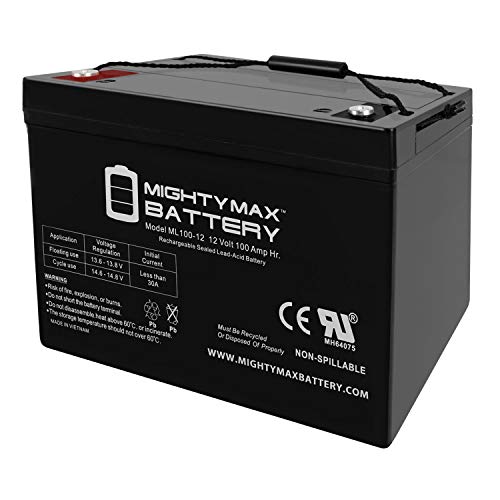 4. Mighty Max Battery ML100-12 12V 100Ah SLA AGM Battery — best for solar-supported touring | Check price on Amazon | |
 5. LiTime 12V 100Ah LiFePO4 Battery, Group 31 — best lightweight upgrade | Check price on Amazon |
Key takeaways
- Five heavy duty leisure batteries compared: AGM and LiFePO4 deep-cycle picks for caravans, motorhomes and campervans, with capacity, cycle life and fit guidance.
As an Amazon Associate we earn from qualifying purchases.
Affiliate Disclosure: This article contains affiliate links. If you buy through a link on this page, we may earn a commission at no extra cost to you. Product specifications are taken from the manufacturers’ listings; we have not personally tested these batteries.
What heavy duty means for a leisure battery
A leisure battery powers everything in a caravan, motorhome, or campervan that is not the engine: lights, water pump, heating controls, television, phone charging, and increasingly a compressor fridge and a small inverter. Heavy duty, in this context, does not mean a bigger starting battery. It means a deep-cycle battery built to be discharged substantially and recharged hundreds of times without rapid damage, with a case, terminals, and internals that tolerate vibration, partial charging from solar, and long periods off grid.
Two chemistries dominate the serious end of this market. Absorbed glass mat, or AGM, is sealed lead-acid: no topping up, no spills, tolerant of standard leisure chargers and split-charge systems, but heavy and happiest when you use only about half of its rated capacity. Lithium iron phosphate, or LiFePO4, costs more up front, weighs roughly a third as much for the same rating, and can use most of its rated capacity, but it needs a charger with a lithium profile and a battery management system, or BMS, to protect the cells. Both types appear in the picks below, and each pick states its chemistry clearly so you can match it to the charger already fitted in your vehicle.
Sizing comes before brand. Work out your daily consumption in amp-hours, decide how many days you want between charges, and then divide by the usable fraction: roughly one half for AGM, and most of the rating for LiFePO4. A typical touring setup with LED lights, a pump, device charging, and a compressor fridge lands in the 100 amp-hour class, which is why every pick below sits at 100 amp-hours or just above. Also measure the battery box before ordering. Group 31 batteries are longer than Group 27, and a battery that does not fit the tray or clear the lid is not a bargain at any specification.
Our picks at a glance
- Best overall AGM: Renogy 12V 100Ah Deep Cycle AGM Battery — ASIN B075RFXHYK
- Best value AGM: WEIZE 12V 100Ah Deep Cycle AGM Battery, Group 31 — ASIN B0BGKHQQTP
- Most capacity in an AGM case: Interstate Batteries 12V 110Ah SLA/AGM Deep Cycle Battery (DCM0100) — ASIN B00YB26RYG
- Best for solar-supported touring: Mighty Max Battery ML100-12 12V 100Ah SLA AGM Battery — ASIN B00S1QCK94
- Best lightweight upgrade: LiTime 12V 100Ah LiFePO4 Battery, Group 31 — ASIN B0BJ78JZ2B
1. Renogy 12V 100Ah Deep Cycle AGM Battery — best overall AGM
The Renogy is the default recommendation for a heavy duty leisure battery in the AGM class because its published specification is unusually complete. It is a 12 volt, 100 amp-hour deep-cycle AGM battery with a maximum discharge current of 1100 amps for five seconds, a monthly self-discharge rate below 3 percent, and a sealed, maintenance-free design. Renogy lists 500 cycles at 50 percent depth of discharge, dimensions of 13.1 by 6.9 by 8.6 inches, and a weight of 63.9 pounds, with M8 terminal bolts included and support for series connections and parallel banks of up to four batteries.
For caravan and motorhome use, the practical points are the low self-discharge in storage, the tolerance of standard AGM charging voltages, and the ability to expand to a two-battery bank later without changing brand or chemistry. The honest limits are the same as any AGM: plan on about half the rated capacity as your daily usable budget, recharge promptly after a trip rather than storing it discharged, and expect to lift nearly 64 pounds into the battery locker, ideally with two people.
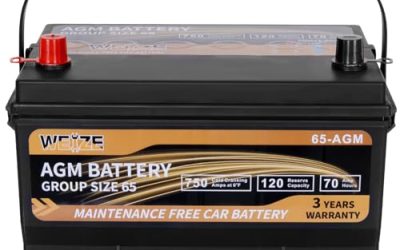
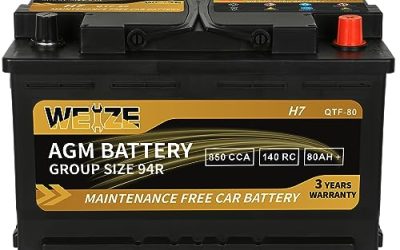
2. WEIZE 12V 100Ah Deep Cycle AGM Battery, Group 31 — best value AGM
The WEIZE takes the same 100 amp-hour brief and puts it in a Group 31 case. Its listing describes a 12 volt deep-cycle AGM battery with a maximum discharge current of 1150 amps, a self-discharge rate of 3 percent, and a heavy-duty calcium-alloy grid intended to serve both float and cyclic applications, aimed at RV, solar, camping, cabin, marine, and off-grid systems. A one-year warranty is stated in roundups of the listing.
Choose the WEIZE when the battery tray genuinely fits Group 31 and the rest of your system is a conventional AGM setup. The Group 31 footprint is the deciding check: it is larger than the Renogy’s case class, so measure length as well as height, including cable bend space at the terminals. As with the Renogy, treat roughly half the nameplate capacity as the working budget and pair it with a charger that has a proper AGM profile rather than a basic automotive charger left connected indefinitely.
3. Interstate Batteries 12V 110Ah SLA/AGM Deep Cycle Battery (DCM0100) — most capacity in an AGM case
The Interstate DCM0100 is the capacity pick. It is a 12 volt, 110 amp-hour SLA/AGM deep-cycle battery, giving roughly ten percent more stored energy than the 100 amp-hour models in the same general footprint. The maker specification lists 110 amp-hours at the 20-hour rate, dimensions of 12.99 by 6.81 by 8.35 inches, insert terminals with bolts, a maximum discharge of 1200 amps for five seconds, and a 12-month performance warranty. Weight is listed at about 67.5 to 71.5 pounds depending on the source document, so treat it as the heaviest lift in this guide.
That extra capacity suits longer off-grid stays in a motorhome where the fridge and heating run daily and solar input is limited. Two cautions apply. First, this model also has a strong presence in mobility applications, so confirm the terminal style matches your leisure cabling before ordering. Second, the extra amp-hours do not change AGM discipline: the usable budget is still about half the rating, and the battery still wants a full recharge as soon as facilities allow.
4. Mighty Max Battery ML100-12 12V 100Ah SLA AGM Battery — best for solar-supported touring
The Mighty Max ML100-12 is a 12 volt, 100 amp-hour sealed lead-acid AGM battery with internal-thread terminals, listed in a Group 27 case at about 12.09 by 6.65 by 8.48 inches in current roundups, and described as UL certified. It is explicitly a deep-cycle battery rather than a starting battery, positioned for solar arrays, backup banks, and vehicle house systems.
The smaller Group 27 footprint is its main advantage for leisure use: many caravan battery boxes that reject a Group 31 will accept a Group 27, and the internal-thread terminals give a clean bolted connection for ring-terminal leisure cabling. If your touring pattern is a solar panel on the roof topping the battery up daily, a 100 amp-hour AGM of this size is a coherent, simple system that works with the charger already fitted in most vans. Confirm the exact variant before buying, because the ML100-12 name is used across several terminal and case versions.
5. LiTime 12V 100Ah LiFePO4 Battery, Group 31 — best lightweight upgrade
The LiTime is the pick for owners whose limiting factor is payload. It is a 12.8 volt, 100 amp-hour lithium iron phosphate battery in a Group 31 case, weighing 24.25 pounds — roughly forty pounds less than the AGM batteries above — with a built-in 100 amp BMS, a stated charging voltage of 14.4 volts plus or minus 0.2, a recommended charge current of 20 amps, maximum continuous charge and discharge currents of 100 amps, and dimensions of 13 by 6.77 by 8.43 inches. The maker states cycle life figures of 4000 or more cycles at full depth of discharge, rising at shallower discharge, and the battery is intended for RV, travel trailer, solar, marine, and off-grid house use — explicitly not for engine starting.
The upgrade is not plug-and-forget. Your charger needs a lithium profile, a battery-to-battery charger in a motorhome should be set for lithium, and the BMS low-temperature behaviour matters for winter touring, since lithium cells should not be charged below freezing unless the model provides protection or heating. In return you get nearly the full rated capacity as usable energy, far faster charging, and a battery one person can lift safely. For a payload-sensitive campervan conversion, that trade is usually decisive.
How to choose between these five
Start with the charger you already own. If your motorhome or caravan has a conventional lead-acid charger and split-charge relay and you do not plan to change them, stay with AGM: the Renogy for the most complete published specification, the WEIZE if Group 31 fits and value leads, the Interstate for the largest AGM capacity, and the Mighty Max where a Group 27 box or solar-topped touring defines the job. If payload is tight, your fridge runs constantly, or you regularly stay off grid for several days, the LiTime lithium pick repays its higher purchase cost in usable capacity and weight saved, provided you budget for the correct charger settings at the same time.
Whichever chemistry you choose, fit matters as much as capacity. Measure the tray in all three dimensions, check terminal position and type against your existing cables, and confirm the lid closes without pressing on the terminals. Finally, buy the battery as part of a system: a suitable charger, sound cabling, and a simple state-of-charge monitor will do more for real-world reliability than stepping up one capacity class while keeping tired ancillaries.
Bottom line
For most caravan and motorhome owners, the Renogy 100Ah AGM is the safest heavy duty leisure battery recommendation: complete published data, low self-discharge, and an easy path to a two-battery bank. The WEIZE and Mighty Max cover value and smaller-box fits, the Interstate adds the most AGM capacity, and the LiTime is the right answer when weight and usable capacity matter more than sticking with lead-acid. All five listings should be re-checked for live availability at the point of purchase, as heavy batteries move in and out of stock and are sometimes sold through marketplace sellers rather than directly.