Our Short List of 3

All 4 Picks at a Glance
| Product | Specs | Action |
|---|---|---|
| 1. WEIZE Platinum AGM Battery, Group 94R (H7) — Best for 94R/H7 Trucks | Check price on Amazon | |
 2. ACDelco Gold 94RAGM — The Branded Alternative in 94R/H7 | Check price on Amazon | |
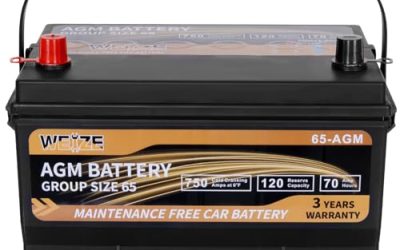
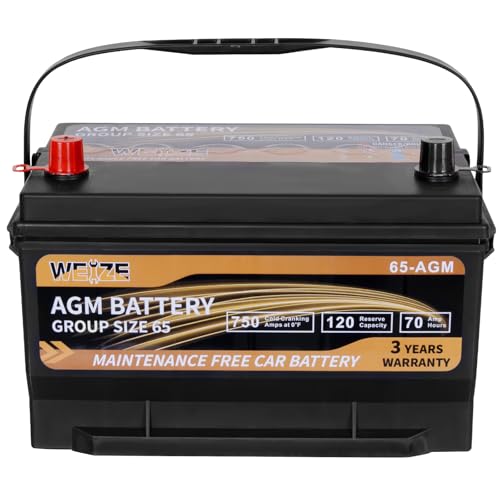 3. WEIZE Platinum AGM Battery, Group 65 — Best for 2004–2014 Trucks | Check price on Amazon | |
 4. Interstate Batteries Group 65 AGM — A Second Group 65 Option | Check price on Amazon |
Key takeaways
- Find the best F150 truck battery by matching your truck's group size first: Group 65 for older trucks, 48/H6 and 94R/H7 AGM for newer ones, with CCA and reserve specs compared.
As an Amazon Associate we earn from qualifying purchases.
Affiliate Disclosure: This article contains affiliate links. If you buy through a link on this page, we may earn a commission at no extra cost to you. Product specifications are taken from the manufacturers’ and sellers’ published listings, and we have not personally tested these batteries.
The Ford F-150 does not take one single battery. Depending on the model year, engine and trim, the truck left the factory with a Group 65 battery, a Group 48 (H6) battery or a larger Group 94R (H7) battery, and the diesel used an even bigger H8 case in some years. That is why “best” only means anything after the group size is settled: a battery that does not match the tray, the hold-down and the terminal layout is the wrong battery no matter how strong its numbers look. This guide therefore works size first. It explains which group size belongs to which generation of F-150, then lists one or two well-documented AGM options for each of the main sizes, with the cold cranking amps, capacity and reserve capacity figures published for each one.
A second point runs through every pick below. Modern F-150s with auto start-stop were built around AGM batteries, and replacing an AGM with a cheaper flooded battery invites short life and start-stop faults. Every battery in this list is an AGM, so each one is a like-for-like chemistry match for the trucks that shipped with AGM, and a sensible sealed upgrade for older trucks that shipped with a flooded Group 65.
Find Your F-150’s Group Size First
Start with the label on the battery already in the truck. The group size is printed on the top or side label, and it settles the question faster than any fitment chart. If the label is unreadable, the owner’s manual lists the specified battery for your engine, and the broad pattern across generations is as follows.
Trucks from roughly 2004 to 2014 use Group 65 in most trims and engines. It is a wide case, about 12.05 inches long, with the positive terminal on the left in the common layout. From 2015 onward, Ford moved to European-style sizes: Group 48, also called H6, became the standard fit on many trucks, while Group 94R, also called H7, appears on higher trims, on many start-stop trucks and as an optional larger fit. The 3.0L Power Stroke diesel used the H8 (Group 49) case in its production years. From 2021 onward the picture stays mixed, with H6 standard and H7 optional on common gas engines, so two trucks of the same year can legitimately take different batteries.
Two measurements protect you when sources disagree, and they do disagree for some years and engines. Measure the length and width of the old case, and note which side the positive terminal sits on. Group 48 and Group 94R both place the positive terminal on the right, while the common Group 65 layout places it on the left. If a replacement’s terminals are reversed for your truck, the cables may not reach, and forcing them risks a short against the hold-down or bodywork.
The Picks at a Glance
| Battery | Group size | CCA | Capacity | Reserve capacity |
|---|---|---|---|---|
| WEIZE Platinum AGM 94R | 94R / H7 | 850 | 80 Ah | 140 min |
| ACDelco Gold 94RAGM | 94R / H7 | 850 | 80 Ah | 140 min |
| WEIZE Platinum AGM Group 65 | 65 | 750 | 70 Ah | 120 min |
| Interstate Batteries Group 65 AGM | 65 | 750 | 68 Ah | Not stated in the sources read |
1. WEIZE Platinum AGM Battery, Group 94R (H7) — Best for 94R/H7 Trucks
For F-150s whose label reads 94R or H7, the WEIZE Platinum AGM is the most completely documented option in this size. The published figures are 850 cold cranking amps, 80 amp-hours of capacity and 140 minutes of reserve capacity, in a case measuring 12.4 by 6.89 by 7.48 inches, with tapered terminals arranged negative on the left and positive on the right. Those numbers match the larger factory AGM fitment Ford uses on start-stop trims, so the battery is sized for repeated restart cycling rather than just the first start of the day.
The AGM construction matters here for two reasons. The electrolyte is held in glass mat separators, so the battery is sealed, spill-resistant and more tolerant of the vibration a truck battery lives with. The listing also describes a low self-discharge rate in storage and an operating temperature range suited to both cold starts and hot engine bays, and it states a 36-month warranty. Charging guidance in the listing gives a charging voltage range of 14.4 to 15.0 volts, which lines up with the charging profile a modern F-150 alternator and battery management system expects from an AGM.
Choose this battery if your truck’s existing battery is a 94R/H7 and you want the strongest published cranking figure in that size. Skip it if your truck takes Group 48 or Group 65: the 94R case is longer than a Group 48, and no amount of specification advantage makes the wrong case a good buy.
2. ACDelco Gold 94RAGM — The Branded Alternative in 94R/H7
The ACDelco Gold 94RAGM (part 88864542) covers the same Group 94R/H7 fitment as the WEIZE above, which makes it the direct comparison for buyers who prefer a long-established battery brand. Published data for this battery gives the same case dimensions, 12.4 by 6.9 by 7.5 inches, a weight of about 51.6 to 53.2 pounds depending on the source, and, from ACDelco’s own specification data, 80 amp-hours at the 20-hour rate and 140 minutes of reserve capacity, with a cold cranking rating in line with the 94R class.
ACDelco describes the construction as maintenance-free AGM with a leak-proof pressurized valve system, high-density plate oxide for power per pound, and a puncture-resistant envelope separator intended to support acid circulation and prevent internal shorts. The battery carries a 36-month warranty, and ACDelco notes that its Gold line was formerly sold under the Professional name, which is worth knowing if you are comparing an older listing or a box on a shelf against this one.
Between the two 94R picks, the honest summary is that the published headline figures are very close. The WEIZE listing publishes its full specification set more openly, while the ACDelco brings the backing of a major original-equipment supplier. Either way, confirm the 94R/H7 size on your old battery’s label before ordering, because this size does not fit trucks built for Group 48 or Group 65 trays without the correct tray and hold-down.
3. WEIZE Platinum AGM Battery, Group 65 — Best for 2004–2014 Trucks
Older F-150s, broadly the 2004 to 2014 trucks, take Group 65, and the WEIZE Platinum in this size publishes 750 cold cranking amps, 70 amp-hours and 120 minutes of reserve capacity. The case measures 12.05 by 7.56 by 7.56 inches, and the terminal layout is the Group 65 pattern of positive on the left and negative on the right, the mirror image of the 94R picks above. The listing states a 36-month warranty and describes the same sealed AGM construction, with up to twice the cycle life of a conventional flooded battery claimed by the manufacturer.
That cycle-life point is the practical reason to put an AGM in an older truck that originally came with a flooded battery. Work trucks that sit between jobs, trucks that run lights, compressors or a winch with the engine off, and trucks in very hot or very cold regions all cycle their batteries harder than a daily commuter does. A sealed AGM also removes the watering and terminal-corrosion routine that comes with a flooded case, though you should still keep the terminals clean and the hold-down tight, because a loose battery of any chemistry dies early from vibration.
Check the charging note in the listing before you buy: it gives a charging voltage of 14.4 to 15.0 volts and an acceptable charging current range. An older truck’s charging system is simpler than a modern start-stop system, and an AGM is generally compatible with it, but if your truck has an aftermarket charger or a battery maintainer, confirm it has an AGM setting.
4. Interstate Batteries Group 65 AGM — A Second Group 65 Option
Interstate’s Group 65 AGM lists 750 cold cranking amps and 68 amp-hours, putting it very close to the WEIZE Group 65 on the two figures that matter most for starting. It is a sealed AGM from one of the largest battery distribution networks in North America, which is the main reason to shortlist it: if warranty service or a local exchange ever matters to you, a widely distributed brand is easier to deal with than a listing-only name.
The published information available for this battery is thinner than for the WEIZE. The sources read for this guide did not state a reserve capacity figure for it, so if reserve capacity is your deciding factor — for example, because you run accessories with the engine off — treat that as an open question to confirm on the product page before ordering rather than assuming it matches the WEIZE’s 120 minutes. Dimensions and terminal layout follow the Group 65 standard, but as with every pick here, compare them against your old battery rather than trusting the group label alone.
How to Choose Among These Four
Decide in this order. First, group size, taken from the old battery’s label or the owner’s manual: 94R/H7 trucks choose between picks one and two, Group 65 trucks choose between picks three and four, and Group 48/H6 trucks should look for the equivalent AGM batteries in that size rather than forcing any battery listed here into the tray. Second, cold cranking amps: match or exceed the figure on your old battery, especially if the truck lives in a cold climate or has a diesel-adjacent starting load from accessories. Third, reserve capacity, if you regularly power lights, radios, inverters or a trailer with the engine off. Fourth, warranty handling: a battery is heavy and awkward to return by courier, so the practical value of a warranty depends on how easily you can use it.
Two installation notes apply to every F-150 battery swap. On 2015 and newer trucks, the battery management system tracks battery age and charging, and Ford’s guidance is that the system should be reset when a new battery is fitted so the charging strategy matches the new battery; a dealer, a suitably equipped independent shop or the truck’s documented reset procedure can do this. And on any truck, photograph the cable routing before you disconnect anything, remove the negative cable first, and fit it last.
Frequently Asked Questions
What group size battery does an F-150 take? It depends on the year and engine. Most 2004–2014 trucks take Group 65. Most 2015 and newer gas trucks take Group 48 (H6), with Group 94R (H7) on many start-stop and higher-trim trucks, and H8 on the 3.0L diesel. The label on your current battery is the final answer.
Can I put a bigger group size in my F-150? Only if the tray, hold-down and cable reach genuinely suit it. Some newer trays accept more than one size, but a battery that sits loose or strains the cables is a failure waiting to happen. Match the specified size unless you can verify the larger case fits properly.
Does my F-150 need an AGM battery? If it has auto start-stop, yes — those trucks were specified with AGM, and a flooded battery will usually live a short life in that duty. Older trucks without start-stop can use either, with AGM offering sealed, maintenance-free construction and better cycling tolerance.
How long should an F-150 battery last? Heat, deep discharges and short-trip driving shorten battery life more than age alone. A battery that is kept charged, held down firmly and not repeatedly flattened should give several years of service; repeated jump-starts are a sign to test the battery and the charging system rather than to keep nursing it.
What do CCA and reserve capacity mean? Cold cranking amps describe how much current the battery can deliver for starting in cold conditions, and reserve capacity describes how long it can supply a moderate load with the engine off. Match CCA to your old battery or better, and weight reserve capacity more heavily if you use accessories with the engine stopped.