Key takeaways
- Open-mouth tote: a wide opening for large tools like drills, levels and plumbing wrenches. Best for general repair, plumbing and carpentry.
- Backpack: keeps both hands free for ladders and stairs, and spreads weight across the back. Common with electricians and HVAC techs.
- Canvas tote or bag: a classic zip-top bag with a hard or soft base; cheap, flexible and easy to pack for a household toolkit.
- Rolling bag: for long walks across a site, at the cost of bulk and stair climbing.
For most homeowners and tradespeople, a wide-mouth, open-top tote such as the DeWalt 20-inch PRO Open Mouth Tool Bag is the easiest bag to live with, an organizer-style backpack from Klein or DeWalt suits electricians and anyone who climbs ladders, and a simple canvas tote is enough for a small household kit. All of these fall inside a $150 budget, so the choice comes down to how you carry, how many pockets you want and how wet or dirty your jobs get.
Our top picks
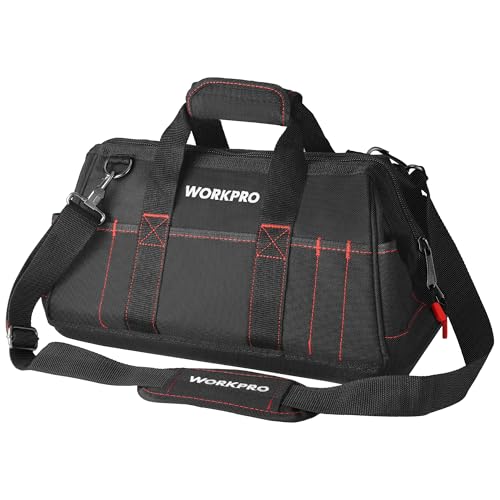


As an Amazon Associate we earn from qualifying purchases at no extra cost to you.
Choose a bag style first
- Open-mouth tote: a wide opening for large tools like drills, levels and plumbing wrenches. Best for general repair, plumbing and carpentry.
- Backpack: keeps both hands free for ladders and stairs, and spreads weight across the back. Common with electricians and HVAC techs.
- Canvas tote or bag: a classic zip-top bag with a hard or soft base; cheap, flexible and easy to pack for a household toolkit.
- Rolling bag: for long walks across a site, at the cost of bulk and stair climbing.
At a glance
| Bag | Best for | Key stated specs | Limits |
|---|---|---|---|
| DeWalt 20 in. PRO Open Mouth Tool Bag (DWST560104) | Plumbing, carpentry, general trade work | The maker lists 1680 denier fabric with tarpaulin, 33 pockets, a 55 lb (25 kg) capacity per retailer listings, an IP54-rated water-resistant compartment with waterproof base, 20 x 11-3/8 x 12-1/8 inches, padded shoulder strap, limited lifetime warranty | Large when full; the water-resistant rating applies to the compartment, not the whole bag |
| DeWalt 18 in. PRO Backpack (DWST560102) | Ladder work, electricians, tech visits | The maker lists a laptop compartment, a drill and battery compartment, 1680 denier polyester and tarpaulin, and a limited lifetime warranty; retailer listings give 43 pockets and a 55 lb (25 kg) capacity | Large and heavy when full; pocket counts vary between listings, so judge by layout |
| DeWalt 12 in. PRO Gear Bag (DWST560110) | Compact kits, small repairs, add-on bag | The maker lists 12 pockets, a 33 lb (15 kg) load capacity and a 1680D fabric with a tarpaulin front | Small opening footprint; not for long levels or large saws |
| Klein Tradesman Pro Tool Station backpack (62482) | Electricians, mobile work with a stowable workstation layout | Klein’s catalog lists 27 pockets (18 interior, 9 exterior), a front flap that opens out into a workstation, and a molded base | Backpack layouts take some learning; heavier when loaded |
| Klein Tool Runner (62804) | Pocket-heavy organization in a tote | Klein’s catalog lists 39 pockets | Pocket-heavy designs take time to organise |
| Klein Deluxe canvas bag | Household and light-trade kits | Klein lists an 18-inch canvas bag with 13 pockets and a 24-inch canvas bag with 17 pockets | Canvas absorbs moisture; less rigid than molded-base bags |
What to look at when comparing bags
Base and water resistance
A waterproof or molded base keeps tools off wet ground, which matters on lawns, basements and bathroom floors. DeWalt’s PRO bags carry an IP54-rated water-resistant compartment with a waterproof base, according to the maker. IP54 is a limited rating: it describes protection against dust ingress and splashing water, not submersion, so treat it as protection from drips and spray.
Fabric
1680 denier fabric appears in DeWalt’s pages for the 20-inch bag, the 18-inch backpack and the 12-inch gear bag. Higher denier counts generally mean thicker, more abrasion-resistant weave. Canvas, as in the Klein Deluxe bags, wears well but absorbs moisture unless treated.
Pockets and layout
More pockets help organise small items, but not every pocket is useful. Look for a mix of deep pockets for pliers and tape measures, shallow pockets for screwdrivers, and straps for levels. DeWalt’s 20-inch bag lists dedicated slots for a cordless drill and battery, plus straps for levels, tape measures and a carabiner. Klein’s catalog numbers (27 and 39 pockets on the Tradesman Pro backpack and Tool Runner) show how much organization the company emphasises in its professional bags.
Handles and straps
Padded shoulder straps matter on long carries. DeWalt’s 20-inch bag includes a carry handle and shoulder strap. If you carry a bag one-handed for long stretches, check the handle padding and attachment points.
Weight and capacity planning
A loaded tool bag gets heavy quickly. DeWalt’s 12-inch gear bag lists a 33 lb (15 kg) capacity, a useful benchmark for similar compact bags. For larger bags, do not rely on pocket counts; pack the heaviest items lowest and nearest your back, and avoid overloading the bag past what you can carry safely. If your kit is heavy, favour a backpack or a rolling bag.
Packing a basic homeowner’s kit
- Claw hammer, tape measure, and a combination square
- Screwdrivers (Phillips and flat), adjustable wrench and pliers
- Utility knife with spare blades in a closed case
- Cordless drill with a small bit set
- Stud finder, level and pencil
- Gloves and safety glasses
For bathroom and plumbing jobs, add an adjustable wrench, plumber’s tape and a bucket-style tote or small tray for catching drips.
Safety and care
- Store knives and blades in sheaths or cases before putting them in a pocket.
- Keep batteries separate from loose metal items to avoid contact between terminals.
- Do not overload bags beyond what you can lift safely; lift with your legs.
- Empty and air out wet bags after use to avoid rust on tools and odours in the fabric.
Budget tiers within a $150 ceiling
| Tier | What it usually buys | Trade-off |
|---|---|---|
| Budget | A canvas tote or compact gear bag | Fewer pockets; less weather protection |
| Mid-range | A DeWalt or Klein open-mouth tote with a waterproof base | Larger and heavier |
| Upper end of the cap | A professional backpack or a rolling bag, depending on the model | Pocket layouts take time to learn; reaching the cap may require a model on the larger side |
Pick X if…
| Pick | If you… |
|---|---|
| DeWalt 20 in. open-mouth tote | carry mixed tools to repair jobs and want a waterproof base |
| DeWalt 18 in. backpack | climb ladders and want a laptop and drill compartment |
| DeWalt 12 in. gear bag | need a compact add-on or a small household kit |
| Klein Tradesman Pro backpack | are an electrician or technician who values pocket organisation |
| Klein canvas bag | want a simple, traditional bag for light use |
Alternatives
- Milwaukee PACKOUT soft and modular storage, a modular system that leans toward boxes more than soft bags.
- Husky tool bags, a store-brand route that usually costs less; compare pocket count and base construction.
- A hard toolbox, such as a stackable case, for tools that need crush protection.
Organizing inside the bag
A bag works best when it is packed with intent. Put the tools you use every job in the outer and top pockets, and reserve the main compartment for bulky items such as a drill, a level or a saw. Keep fasteners in small cases so they do not scatter, and use pouches or a small zipped bag for items that you grab and take to the work area. Label small bins if you share the bag with others.
It also helps to build two kits. A compact 12-inch gear bag, like DeWalt’s, holds a fast-response set for quick repairs, while a larger tote or backpack carries everything else for planned jobs. That split keeps the daily bag light and means a small errand does not require lifting a full-sized kit.
Fit for bathroom and plumbing work
Bathroom sink and fixture repairs involve water, so choose a bag with a waterproof base and a wide mouth for easy access when you are kneeling. Keep a rag and a small container for drips inside the bag, and store adjustable wrenches, basin wrenches, pliers and plumber’s tape together. Avoid canvas bags on wet floors unless they have a base, and dry everything out after the job so fittings and steel tools do not rust.
Wear points to watch
- Zippers: dirt and overloading are the usual causes of failure, so keep the teeth clean.
- Handles and strap anchors: look at stitching where loads concentrate.
- Base: a molded or reinforced base keeps its shape but can crack if dropped from height.
- Pockets: heavy items in small pockets can tear seams over time.
Frequently Asked Questions
Is a backpack better than a tote for tools?
A backpack frees both hands and spreads weight, so it suits ladder work and stairs. A tote offers easier access to large tools and is quicker for single-room jobs. Many pros own both and pack according to the job.
What does IP54 mean on a tool bag?
It is a protection rating that covers limited dust ingress and water splashes from any direction. It does not mean waterproof for immersion, so avoid leaving a bag in standing water.
How many pockets do I really need?
For a household kit, ten to fifteen is plenty. Electricians and technicians who carry many small items may value 27 or more, as in Klein’s pocket-rich designs. Layout quality matters more than raw count.
Are canvas bags still worth buying?
They are inexpensive, tough and familiar, and Klein still lists 18-inch and 24-inch canvas bags. They absorb moisture and lack a rigid base, so keep them off wet floors and dry them after use.
How do I keep tools from rusting in a bag?
Dry tools after wet jobs and let the bag air out. A light wipe of oil on steel surfaces and a small desiccant pack can help. Avoid leaving a wet bag zipped shut in a hot vehicle.
What warranty should I expect?
Terms vary. DeWalt’s pages for its 20-inch tote and 18-inch backpack list a limited lifetime warranty. Read the specific model’s warranty rather than assuming it matches the brand.