Key takeaways
- A beam torque wrench as a low-cost backup.
- A torque screwdriver for very small fasteners in electronics or bicycles.
- A professional shop for critical fasteners if you are unsure about the procedure.
For most home mechanics and DIYers, a 3/8-inch drive click-type (micrometer) wrench with a range around 10 to 100 ft-lb covers the largest share of jobs, a 1/4-inch drive wrench in inch-pounds suits small fasteners and bicycle or electronics work, and a 1/2-inch drive wrench is only needed for wheel nuts and large suspension bolts. Under a $100 cap the realistic choices are click wrenches from Craftsman, Capri Tools and similar value-to-mid brands, with digital wrenches from Craftsman near or above the cap depending on the seller and premium electronic models from GearWrench sitting above it.
Our top picks


As an Amazon Associate we earn from qualifying purchases at no extra cost to you.
What a torque wrench does and does not do
A torque wrench measures tightening force so fasteners are tight enough to hold but not so tight they strip threads or distort parts. It is a measuring tool, not a breaker bar: using it to loosen stuck bolts can damage its mechanism and throw off its calibration. Always use the torque value in the vehicle or equipment manual. If a fastener affects safety, such as brake, suspension, steering or wheel components, and you are unsure of the procedure, have a qualified mechanic do the work.
Match the drive size and range to your jobs
| Drive | Typical range | Good for |
|---|---|---|
| 1/4 inch | Inch-pounds (for example 30 to 150 in-lb) | Small engine parts, bicycle components, interior trim, electronics, valve covers |
| 3/8 inch | Roughly 10 to 100 ft-lb | Engine and brake hardware, most household and general automotive tasks |
| 1/2 inch | Roughly 25 to 250 ft-lb | Lug nuts, suspension bolts, axle hardware |
Accuracy is best between roughly 20 and 100 percent of the scale. GearWrench, for example, states its 85077 electronic wrench is accurate between 20 and 100 percent of the wrench scale. A wrench rated to 250 ft-lb will not be reliable for a 15 ft-lb job, so choose a range where your most common torque values sit in the middle.
At a glance
| Wrench | Best for | Key stated specs | Limits |
|---|---|---|---|
| Craftsman 3/8 in. micrometer (CMMT99433) | General automotive and household use | The maker lists it as a 3/8-inch drive micrometer wrench; retailer listings describe a 20 to 100 ft-lb range with a case; the category page gives no accuracy figure | Read the range printed on the wrench before relying on it for a given job |
| Craftsman 1/2 in. micrometer (CMMT99434) | Lug nuts and larger fasteners | The maker lists it as a 1/2-inch drive micrometer wrench; seller listings describe a 50 to 250 ft-lb click wrench with a carrying case | High minimum setting; not suitable for small fasteners |
| Craftsman 3/8 in. digital (CMMT99435) | Buyers who want a screen and unit switching | The maker lists switching between ft-lb, in-lb and Nm, a backlit LED display and a click-style signal; retailer listings give a 20 to 100 ft-lb range | No accuracy figure on the pages found, and seller pricing for digital models can sit above a $100 cap, so confirm before buying |
| Capri Tools 1/4 in. industrial (31200) | Small fasteners in inch-pounds | Listings describe a 30 to 150 in-lb range, an accuracy of plus or minus 4 percent and a certificate of conformance | Narrow range; too small for wheel hardware |
| GearWrench 85077 electronic 1/2 in. | Premium reference for wheel and suspension work | The maker lists 25 to 250 ft-lb, accuracy of plus or minus 2 percent clockwise and 3 percent counterclockwise between 20 and 100 percent of scale, five units, a 72-tooth ratchet with a 5-degree swing arc, a target torque alert (vibration, buzzer and LED), and a 1-year warranty on parts | Sits in the premium tier, above a $100 cap according to reseller listings |
| Tekton click-type wrenches | Value-oriented alternative from a tool-focused maker | Tekton’s pages list some current 3/8-inch models (for example TRQ51402, 10 to 100 ft-lb) with a certificate of calibration, and mark older models such as the 24330 and 24335 as no longer available | Item numbers change; match the model to the range and drive size you need, and confirm whether a certificate is included |
Click-type, digital or beam
Click (micrometer) wrenches
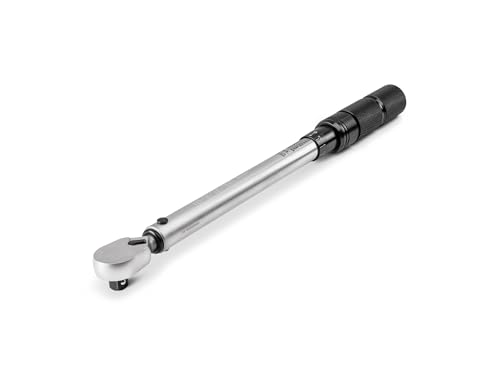
These are the standard choice for home use. You set the target value on the handle, tighten until the wrench clicks, then stop. They are quick and need no batteries. Their accuracy depends on keeping the spring unloaded in storage. Many makers advise winding the setting back to the lowest mark after use; follow your manual.
Digital wrenches
Digital models show torque on a screen and often alert with a beep, vibration or light. Craftsman’s CMMT99435 lists a backlit LED display and unit conversion between ft-lb, in-lb and Nm. Premium electronic wrenches, like the GearWrench 85077, add a stated accuracy figure and a target alert. Digital units cost more and need batteries, so they sit towards the top of, or above, a $100 budget depending on the seller.
Beam wrenches
A beam wrench uses a pointer and a scale. It has no spring to lose calibration and it is inexpensive, but reading the scale in a tight engine bay can be awkward. It is a reasonable backup tool.
Accuracy and calibration
Accuracy figures are typically stated as a percentage, such as plus or minus 4 percent for many click wrenches and plus or minus 2 to 3 percent for premium electronic models. A certificate of calibration or conformance can add confidence, and Tekton’s pages list certificates with some of its current wrenches. For occasional home use, a quality click wrench stored properly is adequate. If you rely on torque values in critical applications, have the wrench checked periodically by a calibration service or replace it if you drop it.
Using a torque wrench correctly
- Clean the threads and check that the fastener turns smoothly by hand before torquing.
- Set the wrench to the value in the manual, using the correct unit (ft-lb, in-lb or Nm).
- Pull smoothly and steadily, holding the handle at the grip, not by the end of an extension.
- Stop at the click, and do not keep pulling.
- For wheels, tighten in a star pattern in stages. Re-check wheel torque after a short drive if the manual calls for it.
- After use, return a click wrench to its lowest setting if the maker advises it, and store it in its case.
Budget tiers within a $100 ceiling
| Tier | What it usually buys | Trade-off |
|---|---|---|
| Budget | A basic 3/8-inch or 1/4-inch click wrench from a value brand | Looser stated accuracy; fewer included extras |
| Mid-range | A micrometer click wrench from Craftsman, Capri or Tekton with a case, and sometimes a certificate | Limited range per wrench; you may need two sizes |
| Upper end of the cap | A digital 3/8-inch wrench or a higher-grade click wrench | Batteries and a screen to look after |
Pick X if…
| Pick | If you… |
|---|---|
| Craftsman 3/8 in. micrometer | want a general-purpose automotive and household click wrench |
| Craftsman 1/2 in. micrometer | mainly torque wheel nuts and large fasteners |
| Craftsman 3/8 in. digital | prefer a screen and unit switching |
| Capri Tools 1/4 in. | work on small fasteners, bicycles or inch-pound specs |
| Tekton click wrench | want a value pick with a certificate of calibration (check that the specific model includes one) |
| GearWrench 85077 | can spend above the cap and want stated accuracy and an alert |
Alternatives
- A beam torque wrench as a low-cost backup.
- A torque screwdriver for very small fasteners in electronics or bicycles.
- A professional shop for critical fasteners if you are unsure about the procedure.
Care, storage and what to avoid
Treat a torque wrench as a measuring instrument. Keep it in its case, away from moisture, and avoid dropping it, since a hard knock can shift its calibration. Do not use it as a hammer, cheater bar or breaker bar. Wipe it clean after use, and keep lubricants away from the handle grip. A case is worth keeping because the original packaging protects the mechanism in storage.
Always keep your hand centred on the grip when pulling, as shifting your hand along the handle changes the leverage and the torque applied. Pull smoothly, because jerking the wrench can overshoot the target. When working in tight spaces, extensions and universal joints can change readings, so keep them straight and short where possible and follow the manual’s guidance.
Unit conversion basics
Torque specs come in foot-pounds, inch-pounds and Newton-metres. There are 12 inch-pounds in one foot-pound, so a spec of 120 in-lb equals 10 ft-lb. A wrench with a dual scale, or a digital model that converts units at the touch of a button, such as the Craftsman CMMT99435, reduces the chance of misreading. Double-check the unit before you tighten, because mixing up foot-pounds and inch-pounds is a common and costly mistake.
Where a torque wrench helps around the home
Bathroom and plumbing hardware is usually tightened by feel, but torque matters in some places: sink and faucet mounting hardware on stone or porcelain can crack if over-tightened, and compression fittings on some supply lines carry torque recommendations. Where a maker publishes a value, a small inch-pound wrench lets you follow it. Bicycles, lawn equipment and car wheels are the other common uses.
Frequently Asked Questions
Which size should I buy first?
A 3/8-inch drive wrench with a range around 10 to 100 ft-lb covers many household and automotive tasks. Add a 1/4-inch inch-pound wrench for small fasteners and a 1/2-inch wrench if you do your own wheels regularly.
How accurate is a budget click wrench?
Many are stated at about plus or minus 4 percent, which is adequate for typical home jobs. Premium electronic models like the GearWrench 85077 state plus or minus 2 percent clockwise. Accuracy depends on staying within the middle of the range and on careful storage.
Should I loosen bolts with my torque wrench?
No. Use a breaker bar or ratchet for loosening. Excess force can damage the wrench’s mechanism and shift its calibration.
Do I need to wind a click wrench back to zero after use?
Many makers advise returning it to the lowest setting to relax the spring. Some manuals say otherwise, so follow the instructions that came with your wrench.
Can I use extensions or adapters?
Straight extensions have little effect, but crow’s foot and offset adapters change the effective length and require a torque correction. Use the formula in your manual, or avoid adapters for critical fasteners.
How often should a torque wrench be calibrated?
Professional shops commonly check them yearly or after a drop. For occasional home use, careful storage and gentle handling go a long way. If you suspect it is off, have it checked or replace it.